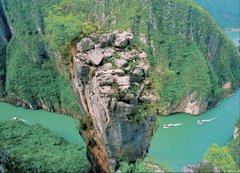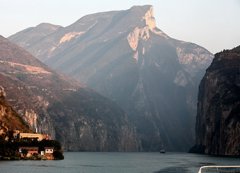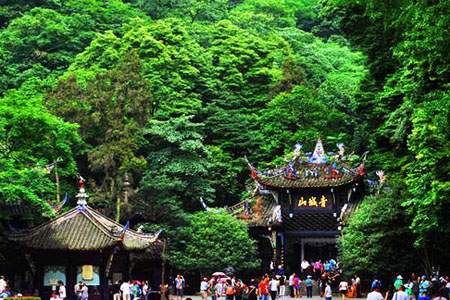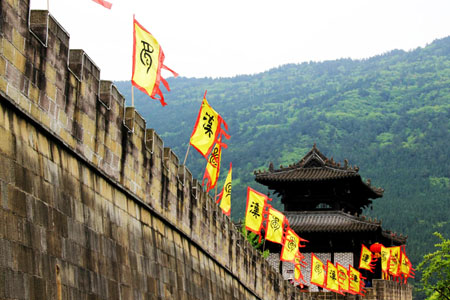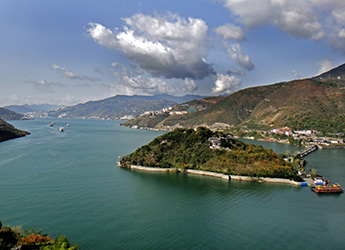
Located on Baidi Hill at the entrance of Qutang Gorge, on the northern bank of the Yangtze River, Baidi City (White Emperor City) is one of the most famous historical and cultural attractions along the Three Gorges route. About 8 kilometers from Fengjie County, this small but historically significant city is surrounded by magnificent mountains, steep cliffs, and the spectacular scenery of the Yangtze River.
With ancient temples, traditional gates, and rich cultural relics scattered across the hilltop, Baidi City offers visitors a unique combination of China’s historical heritage and peaceful natural landscapes.
History and Legend of Baidi City
According to historical records and local legends, Baidi City was founded by Gongsun Shu, an official who later became a military leader during the late Western Han Dynasty.
In 25 AD, Gongsun Shu reportedly saw white mist rising from a nearby well in the shape of a dragon. Believing it was a sign of good fortune, he declared himself the “White Emperor” and renamed the city Baidi City, meaning “White Emperor City.”
Later, Gongsun Shu fought against Emperor Guangwu of Han, but was defeated in 36 AD. After his death, local people built a temple to commemorate him.
During the Ming Dynasty, the temple’s main statues were changed. The statue of Gongsun Shu was replaced by one of Liu Bei, and later additional statues of famous Three Kingdoms figures, including Guan Yu, Zhang Fei, and Zhuge Liang, were added.
 Baidi City and the Three Kingdoms Story
Baidi City is closely connected with one of the most famous stories from the Three Kingdoms period (220–280 AD).
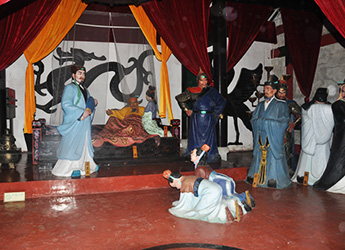
After suffering a disastrous defeat against the Wu Kingdom’s general Lu Xun, Liu Bei, ruler of Shu, retreated to Baidi City. Before his death, he entrusted his kingdom and his young son Liu Chan to his trusted prime minister Zhuge Liang.
This famous historical event is known as the “Entrusting Orphan at Baidi City” and has become one of the most moving stories in Chinese history.
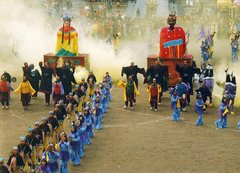
Inside the front hall of Baidi City, large statues recreate this historic scene. The hall also contains the Guanxing Pavilion (Observing Stars Pavilion), where Zhuge Liang was said to have studied celestial movements and used weather observations to assist his military strategies.
The pavilion features traditional Chinese architectural elements, including elegant upturned eaves, polished wooden beams, and a two-story structure supported by 12 lower-floor pillars and 6 upper-floor pillars.
Baidi City – The City of Poems
Beyond its historical importance, Baidi City is also known as the “City of Poems” because of its deep connection with Chinese literature.
Throughout history, many famous poets and scholars traveled here, inspired by the magnificent scenery of Qutang Gorge and the Yangtze River. They left behind numerous poems, inscriptions, and cultural treasures.
Today, the city preserves more than 70 poems, stone carvings, and historical relics from the Sui, Yuan, Ming, and Qing dynasties. Among the most valuable treasures are ancient stone steles, including the Sui Dynasty steles, the Kangxi Emperor Stele, the Bamboo-Leaf Stele, and the Phoenix Stele.
Thanks to its combination of natural beauty, historical stories, and literary heritage, Baidi City remains one of the most important cultural stops on a Yangtze River cruise through the Three Gorges.