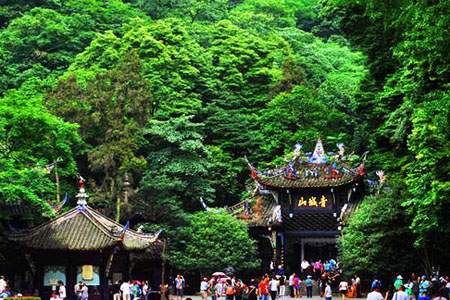
Xichan Temple is one of the five great Zen monasteries of Fuzhou and one of the most important Buddhist temples in Fujian Province. Located on Gongye Road in Gulou District, at the foot of Yishan Mountain and close to Fuzhou University, the temple is renowned for its ancient history, magnificent architecture, and enduring influence on Buddhism throughout Southeast Asia.
As a National Key Buddhist Temple and one of the top Fuzhou attractions, Xichan Temple attracts visitors seeking cultural heritage, religious history, traditional architecture, and a peaceful retreat in the heart of the city.
A History Spanning More Than a Thousand Years
According to local legend, the site was originally home to the alchemist Wang Ba during the Northern and Southern Dynasties. He was said to have refined medicinal elixirs and transformed stones into healing remedies, using his wealth to help local people during times of famine. After his death, a temple was built in his honor, laying the foundation for what would later become Xichan Temple.
The present monastery was first established during the Tang Dynasty and flourished through the Song, Yuan, and Ming dynasties, undergoing several periods of reconstruction and expansion.
In ancient Fuzhou, four major Zen monasteries were built in the city’s eastern, western, southern, and northern suburbs. Because this monastery stood in the western suburb, it became known as Xichan, meaning “West Zen Temple.”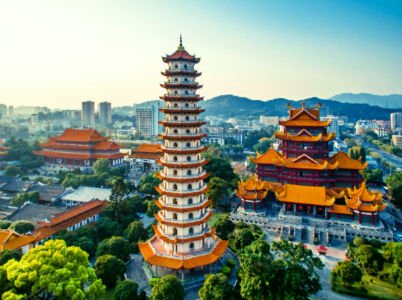
Traditional Buddhist Architecture
Today, Xichan Temple covers more than 60,000 square meters, making it one of the largest temple complexes in Fuzhou.
Following the traditional layout of a Chinese Buddhist monastery, the central axis features:
* Hall of Heavenly Kings
* Mahavira Hall
* Dharma Hall
* Sutra Repository
Additional buildings include meditation halls, Buddha-recitation halls, dining halls, Mingyuan Pavilion, Chongde Hall, and a tranquil Life Release Pond, creating a peaceful environment ideal for quiet reflection and Buddhist practice.
The Magnificent Mahavira Hall
The highlight of the temple is the impressive Mahavira Hall, constructed in the traditional Chinese timber-frame style with elegant double-eaved roofs.
Inside the hall, visitors can admire Tang and Song dynasty stone Buddha platforms, ancient column bases, and finely crafted Buddhist statues. The hall remains one of the finest examples of traditional Buddhist architecture in Fujian Province.
Historic Relics and Ancient Treasures
Xichan Temple preserves an exceptional collection of cultural relics that reflect its long history, including:
* A Tang Dynasty ancient well
* Stone inscriptions and historical tablets
* The pagoda tomb of Master Huiling
* Two Song Dynasty lychee trees that are over 800 years old
* Yuan Dynasty drum-shaped stone relics
* Several historic Buddhist pagodas
These priceless artifacts make the temple an important destination for visitors interested in Chinese history, religion, and architecture.
A Center of Buddhism in Southeast Asia
Beyond its historical significance, Xichan Temple has played a major role in the spread of Chinese Buddhism throughout Southeast Asia. Many famous temples in Singapore, Malaysia, and Vietnam trace their religious lineage to Xichan and continue to maintain close cultural and monastic exchanges with the temple.
Today, monks, pilgrims, and visitors from around the world come to Xichan Temple to participate in religious ceremonies, cultural exchanges, and Buddhist festivals, strengthening the temple’s role as an important bridge between China and Southeast Asia.
Why Visit Xichan Temple?
Whether you’re interested in Buddhist culture, traditional Chinese architecture, ancient history, or simply looking for a peaceful escape from the city, Xichan Temple is one of the best places to visit in Fuzhou.
Its magnificent halls, centuries-old relics, tranquil gardens, and deep spiritual atmosphere offer an unforgettable cultural experience and make it one of the most significant Buddhist landmarks in Fujian Province.