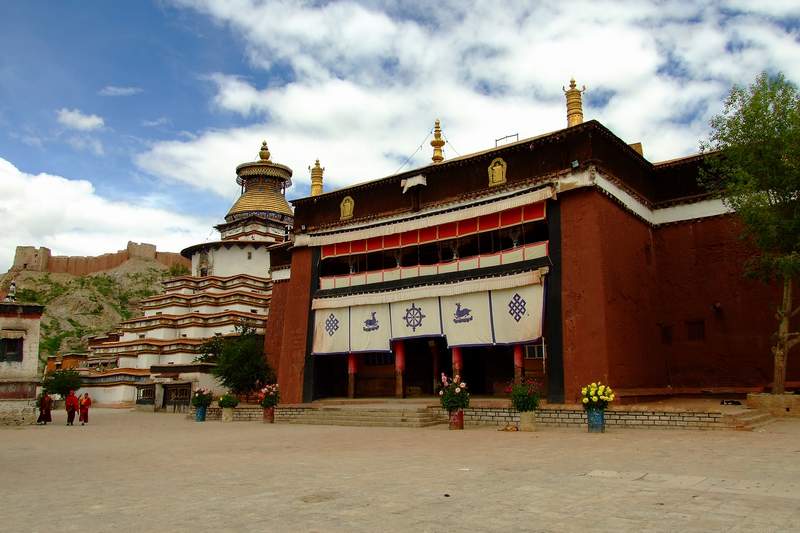
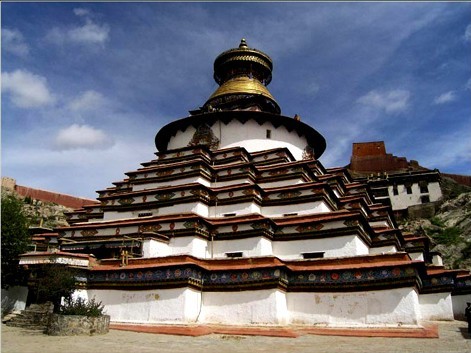
Located inside Pelkhor Chode Monastery in Gyantse County, the Kumbum Stupa is one of the most remarkable Buddhist monuments in Tibet. Commissioned in 1440 by Rabten Kunsang, a prince of Gyantse, this magnificent stupa is the largest of its kind in Tibet and remains one of the region’s most famous cultural landmarks.
The name “Kumbum” means “Hall of 100,000 Images,” reflecting the thousands of Buddhist murals, statues, and religious artworks preserved within the structure. As the centerpiece of Pelkhor Chode Monastery, the Kumbum represents the artistic achievements, religious devotion, and architectural excellence of Tibetan Buddhism.
Architecture and Symbolism of Kumbum Stupa
The Kumbum Stupa is an impressive octagonal structure consisting of five main levels, symbolizing the five stages on the path toward Buddhist enlightenment. The stupa is crowned with a magnificent golden dome, which shines above the surrounding monastery complex.
The dome features four sets of Buddha eyes facing the four directions of the compass. These peaceful and symbolic eyes represent the wisdom and compassion of the Buddha watching over all beings.
The interior of the Kumbum is exceptionally well preserved. Spread across six levels, the stupa contains more than 70 chapels on the lower four floors alone. Each chapel houses exquisite Buddhist statues, colorful murals, and religious artworks that provide valuable insight into Tibet’s spiritual traditions and artistic heritage.
A Treasure House of Tibetan Buddhist Art
The Kumbum Stupa is especially famous for its ancient murals and sculptures. Thousands of beautifully preserved paintings cover the interior walls, depicting Buddhist deities, historical figures, and stories from Buddhist scriptures.
Because of its outstanding artistic value, the Kumbum attracts researchers, historians, and art enthusiasts from around the world. Scholars often visit with reference materials and equipment to study some of the best-preserved examples of traditional Tibetan Buddhist art.
Unlike many other Tibetan monasteries where photography restrictions are common, visitors to the Kumbum are generally allowed to photograph the remarkable Buddhist statues and artworks for a small fee, allowing travelers to capture memories of this extraordinary cultural treasure.
Best Views of Kumbum Stupa
One of the highlights of visiting the Kumbum is reaching the highest level of the stupa. From here, visitors can stand close to the iconic Buddha eyes beneath the golden dome and enjoy panoramic views of Gyantse town and the surrounding Tibetan plateau.
The countryside surrounding Gyantse offers spectacular scenery, with wide valleys, distant mountains, and traditional Tibetan settlements. For the best views of the entire Kumbum Stupa, travelers can also hike to the hills behind Pelkhor Chode Monastery, where the stupa can be seen rising dramatically above the historic town.
Visiting Kumbum Stupa
With its unique architecture, priceless Buddhist artwork, and deep religious significance, the Kumbum Stupa is a must-see attraction for travelers exploring Tibet. Together with Pelkhor Chode Monastery and the historic town of Gyantse, it offers an unforgettable journey into Tibetan history, culture, and spirituality.