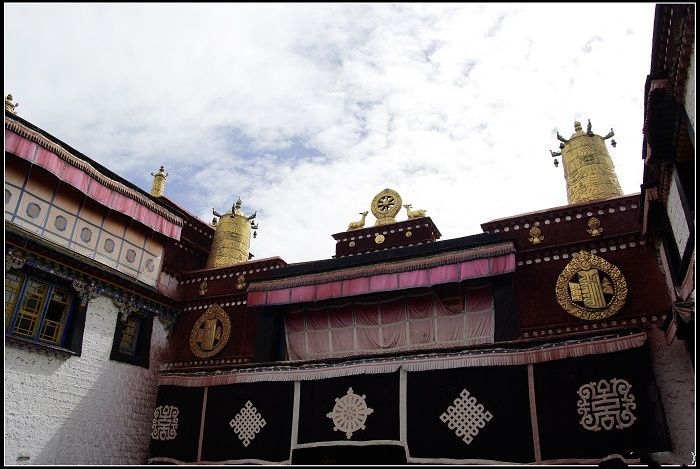
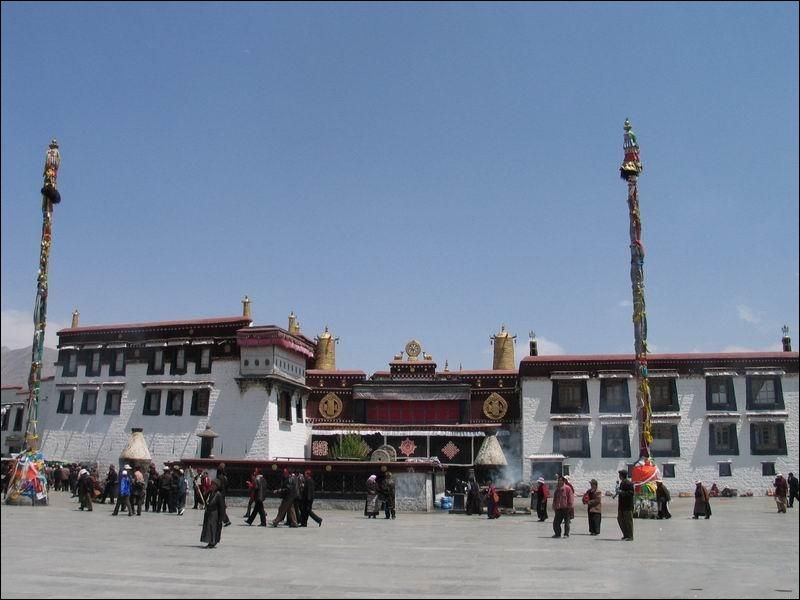
Located in the center of the old city of Lhasa, Jokhang Temple is the first Buddhist temple in Tibet and the most sacred pilgrimage site for Tibetan Buddhists. For centuries, pilgrims from Tibet and neighboring regions such as Qinghai, Gansu, and Inner Mongolia have traveled thousands of kilometers to worship at this holy temple.
As the spiritual center of Tibetan Buddhism, Jokhang Temple represents the perfect combination of Tibetan history, religion, architecture, and culture. Together with the surrounding Barkhor Street, it forms the historical and religious heart of Lhasa.
History of Jokhang Temple
Jokhang Temple was built in the 7th century during the reign of Songtsen Gampo, the great ruler of the Tubo Kingdom (617–650 AD).
According to Tibetan history, Songtsen Gampo strengthened diplomatic and cultural connections by marrying:
* Princess Wencheng of the Tang Dynasty
* Princess Bhrikuti of Nepal
Both princesses brought sacred Buddhist statues to Tibet, including precious images of Buddha Shakyamuni.
At that time, Lhasa had few permanent buildings, and the royal court needed a sacred place to preserve and worship these important Buddhist images. Therefore, two temples were constructed: Jokhang Temple and Ramoche Temple.
Legend of the Construction of Jokhang Temple
According to Tibetan legend, the construction of Jokhang Temple faced repeated difficulties caused by floods.
Princess Wencheng explained that the Tibetan Plateau resembled a giant female demon (Rakshasi) lying on the land, and the lake where the temple was planned was located at the demon’s heart. To establish Buddhism and strengthen the Tubo Kingdom, a temple had to be built over the lake to suppress the negative forces and bring harmony to the kingdom.
Local people filled the lake with earth and stones carried by white goats. Because of this legend, the original name of Lhasa was Rasa, meaning “the place where goats carried earth.”
Inside Jokhang Temple, visitors can still see a small golden statue of a goat, which is worshiped as a sacred symbol of this legendary event.
The Sacred Jowo Rinpoche Statue
The greatest treasure of Jokhang Temple is the Jowo Rinpoche statue, a life-sized statue of Buddha Shakyamuni at the age of twelve.
According to Buddhist tradition, three life-sized statues of Shakyamuni were created based on his appearance at different ages:
* Eight years old
* Twelve years old
* Twenty-five years old
The twelve-year-old statue brought by Princess Wencheng is considered the most precious and best preserved among the three. It is believed by Tibetan Buddhists to represent the actual appearance of Buddha Shakyamuni 2,500 years ago.
For Tibetan pilgrims, visiting Jokhang Temple and seeing the Jowo Rinpoche statue is not simply viewing a historical artifact—it is a sacred opportunity to encounter the living presence of Buddha.
Relationship Between Jokhang Temple and Ramoche Temple
Originally:
* Jokhang Temple housed the eight-year-old Shakyamuni statue
* Ramoche Temple housed the twelve-year-old Shakyamuni statue
In 710 AD, after Princess Jincheng married another Tibetan king, the two statues were exchanged. Since then, the twelve-year-old Shakyamuni statue has remained in Jokhang Temple, becoming the temple’s most revered treasure.
Architecture and Religious Importance
Jokhang Temple combines architectural styles from Tibet, Nepal, and the Tang Dynasty, reflecting the cultural exchanges that shaped early Tibetan civilization.
The temple is divided into several sections, including:
* Main worship halls
* Buddhist chapels
* Monastic areas
* Courtyards decorated with murals and sculptures
Unlike many Tibetan monasteries associated with specific Buddhist schools, Jokhang Temple does not belong exclusively to any one sect. Instead, it serves as the central sacred site for Tibetan Buddhism as a whole.
Center of Tibetan Buddhist Ceremonies
Throughout Tibetan history, Jokhang Temple has played an essential role in religious and political affairs.
During the establishment of the Ganden Phodrang government under the Fifth Dalai Lama, government offices were once located here. Major ceremonies have also traditionally been held at Jokhang Temple, including:
* Dalai Lama and Panchen Lama initiation ceremonies
* Major Buddhist religious events
* The annual Great Prayer Festival (Monlam Chenmo)
Today, the temple remains the spiritual center of Tibetan Buddhism and one of the most important cultural landmarks in Tibet.
Visiting Jokhang Temple
A visit to Jokhang Temple offers travelers a chance to experience the living traditions of Tibetan Buddhism. Outside the temple, pilgrims continue the ancient practice of walking clockwise around the temple with prayer wheels, while some perform full-body prostrations along the pilgrimage route.
For anyone traveling to Tibet, Jokhang Temple is an essential destination to understand:
* Tibetan Buddhist beliefs
* Ancient Tibetan history
* Traditional religious practices
* The cultural identity of Lhasa