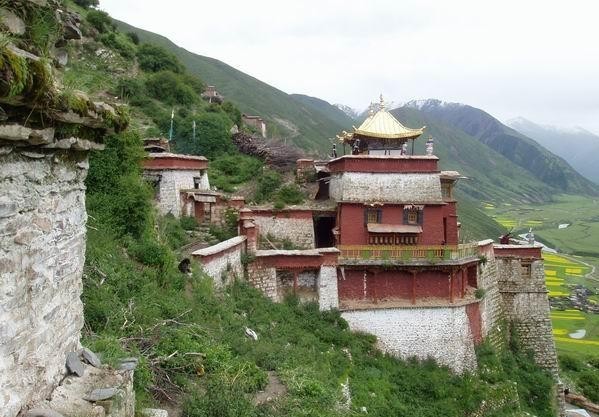
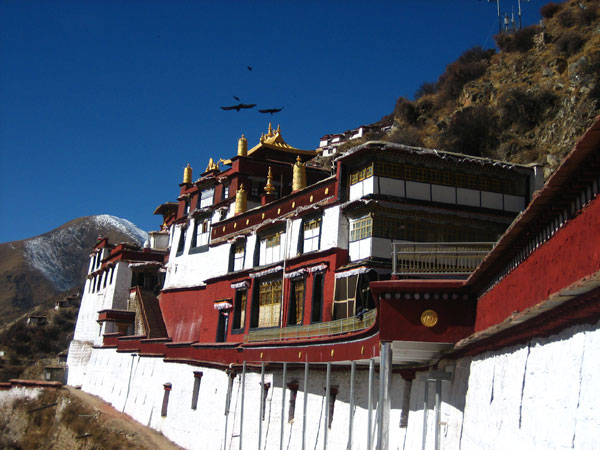
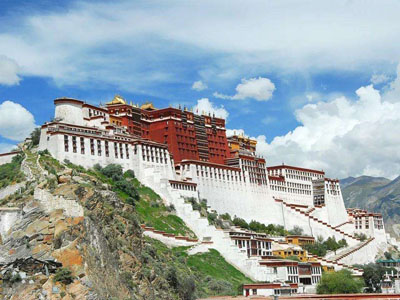
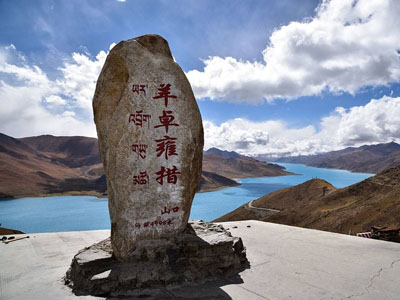
Located on a high and steep ridge overlooking the beautiful Zhorong-chu Valley in Maldro Gongkar County, Drigung Til Monastery is one of the most important monasteries of the Drigung Kagyu tradition of Tibetan Buddhism. Founded in 1179 (the 2nd year of the Chunxi period of the Southern Song Dynasty, according to Tibetan historical records), the monastery serves as the spiritual center of the Drigungpa lineage and remains an important destination for travelers seeking authentic Tibetan Buddhist culture.
Perched on a mountain ridge surrounded by dramatic landscapes, Drigung Til Monastery offers visitors not only a profound religious experience but also breathtaking views of the Tibetan plateau. Today, around 200 monks live and practice Buddhism at the monastery.
History of Drigung Til Monastery
Drigung Til Monastery was founded by Jigten Sumgon, one of the most influential masters of the Kagyu school of Tibetan Buddhism. By the mid-13th century, the monastery had grown into a powerful religious institution and competed with the Sakya School for influence in Tibet.
In 1290, conflicts between the two traditions led to major political changes. After this period, Drigung Til Monastery gradually shifted its focus from political affairs to Buddhist meditation, spiritual practice, and religious education. Over the centuries, it became especially renowned for its teachings on meditation and contemplation.
Architecture and Scenic Views
Built along the natural contours of the mountain ridge, Drigung Til Monastery features traditional Tibetan Buddhist architecture integrated with the surrounding landscape. Visitors can reach the monastery by following a steep mountain path, while vehicles can also access it from the eastern side of the valley.
From the monastery’s main courtyard, travelers can enjoy a spectacular 180-degree view of the Zhorong-chu Valley. The peaceful atmosphere, mountain scenery, and quiet surroundings create a unique sense of spiritual serenity.
The main assembly hall is the most impressive building in the complex. The central statue inside the hall represents Jigten Sumgon, the founder of the monastery. Statues of Padmasambhava (Guru Rinpoche) and Gautama Buddha are placed on either side.
On the upper floor of Serkhang, visitors can see statues of Jigten Sumgon and his two successors wearing traditional red hats. A stone slab at the foot of the statue is believed to preserve Jigten Sumgon’s footprint. Continuing upward, visitors can reach a balcony lined with prayer wheels and see the chortens (stupas) dedicated to former abbots.
Sacred Kora Route and Sky Burial Site
The pilgrimage path (kora) around Drigung Til Monastery follows the mountain ridge and leads to one of the most sacred sky burial sites in the Lhasa region. For centuries, Tibetan people from distant areas have brought deceased family members here for traditional sky burial ceremonies.
Sky burial is a deeply respected Tibetan Buddhist practice symbolizing the impermanence of life and the cycle of existence. Due to the sacred nature of the ritual, visitors are not permitted to watch or photograph active ceremonies.
When no ceremony is taking place, travelers may hike near the site with respect and caution. The area includes the traditional stone platform used for the ritual and nearby buildings associated with the practice. If birds are gathering overhead, it may indicate that a ceremony is underway, and visitors should avoid approaching.
Protector Chapel and Religious Legends
Along the kora route, visitors can return to the monastery and explore the protector chapel (Gongkhang), dedicated to Abchi, the guardian deity of Drigung Til Monastery.
Inside the chapel are important religious images, including a statue of Abchi near the main image of Jigten Sumgon and another depiction of Abchi riding a horse. The chapel also contains an image of Tseringma, a mountain goddess associated with Mount Everest, riding a snow lion.
A pair of yak horns displayed on the chapel wall is connected with local legends about the monastery’s name. One belief suggests that “Drigung” comes from the yak horns, while another says the name refers to the shape of the surrounding hillside, which resembles a yak.
Visiting Drigung Til Monastery
With its ancient Buddhist traditions, dramatic mountain setting, meditation heritage, and sacred pilgrimage routes, Drigung Til Monastery is one of the most rewarding cultural destinations near Lhasa. It offers travelers an opportunity to experience the spiritual depth of Tibetan Buddhism while exploring a less crowded and more authentic monastery away from the city.