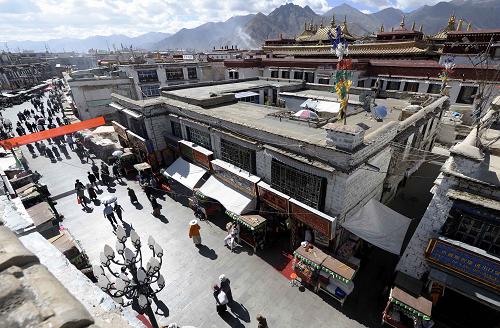
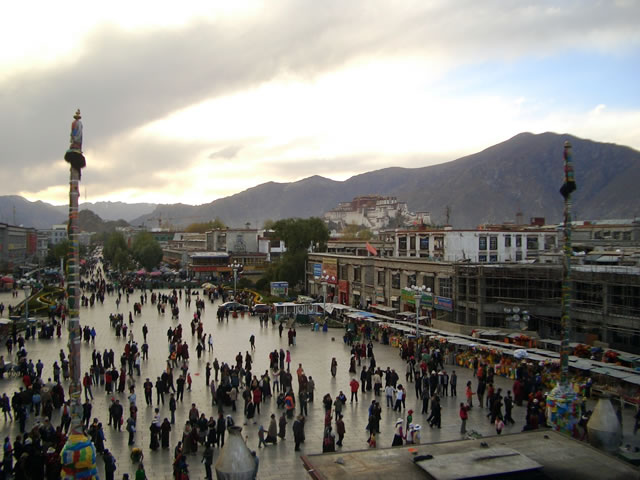
Located in the historic center of Lhasa, Barkhor Street is one of the most famous cultural and religious landmarks in Tibet. Built around the sacred Jokhang Temple, the ancient street forms an important pilgrimage circuit and offers visitors an opportunity to experience traditional Tibetan life, religious customs, architecture, and handicrafts.
As one of the symbols of Lhasa, Barkhor Street is a must-visit destination for travelers exploring the city.
History of Barkhor Street
According to Tibetan historical tradition, Songtsen Gampo, the seventh-century Tibetan king, commissioned the construction of Jokhang Temple after his marriage to Princess Wencheng of the Tang Dynasty and Princess Bhrikuti of Nepal.
As Jokhang Temple became an important Buddhist pilgrimage site, increasing numbers of pilgrims began walking around the temple in a clockwise direction. Over time, the frequently used pilgrimage path developed into the street now known as Barkhor.
The name “Barkhor” refers to the middle circumambulation route around Jokhang Temple. Together with the inner route around the temple and the outer Lingkor route around Lhasa, it forms part of the traditional pilgrimage system of the city.
A Living Tibetan Pilgrimage Route
One of the most memorable experiences at Barkhor Street is watching pilgrims perform their religious practices around Jokhang Temple. From early morning until evening, pilgrims can be seen walking clockwise around the sacred circuit while turning prayer wheels and reciting prayers.
Some pilgrims practice full-body prostrations along the route, repeatedly lowering themselves to the ground before standing and moving forward. Some travel enormous distances from their home regions to reach Lhasa and complete their pilgrimage.
These traditions give Barkhor Street a deeply spiritual atmosphere and provide visitors with a glimpse into the importance of Tibetan Buddhism in everyday life.
Traditional Architecture and Stone-Paved Streets
Barkhor Street retains much of the traditional character of old Lhasa. The narrow streets are paved with hand-finished stone slabs, while traditional Tibetan buildings line both sides of the pilgrimage route.
The area surrounding the street combines religious sites, traditional residences, workshops, restaurants, and small stores. This mixture of everyday life and religious activity makes Barkhor one of the best places in Lhasa to experience the atmosphere of the historic city.
Tibetan Handicrafts and Local Shopping
Barkhor Street is also one of the best places to explore traditional Tibetan handicrafts. Shops and market stalls sell a wide variety of local products, including:
* Tibetan prayer wheels
* Traditional chuba clothing
* Tibetan-style knives
* Buddhist religious objects
* Thangka paintings
* Tibetan jewelry and handicrafts
* Traditional decorative items
Thangka, a traditional Tibetan scroll painting, is particularly significant. These artworks commonly depict Buddhist figures and religious themes, while some also portray Tibetan history, literature, medicine, astronomy, and local customs.
Because of Lhasa’s historic connections with South Asia, visitors can also find handicrafts and goods influenced by neighboring regions such as Nepal and India.
Visiting Barkhor Street
Barkhor Street is more than a shopping district or tourist attraction. It is a living cultural landscape where pilgrims, local residents, monks, craftsmen, and travelers share the same historic streets.
The best way to experience Barkhor is to walk slowly around the pilgrimage circuit, observe traditional Tibetan architecture, visit the shops and workshops, and take time to appreciate the religious atmosphere around Jokhang Temple.
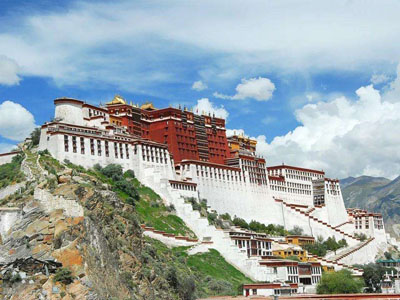
For first-time visitors to Lhasa, Barkhor Street offers one of the most authentic introductions to Tibetan culture and is an essential stop alongside the Potala Palace and Jokhang Temple.