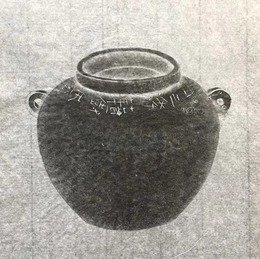
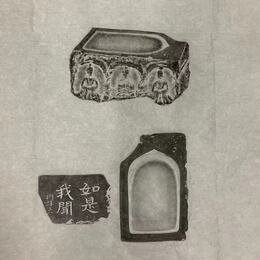
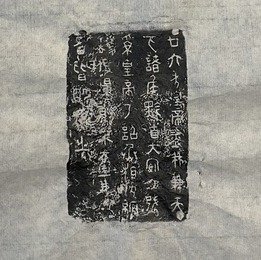
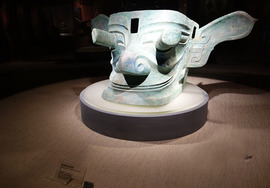
Ink rubbing, known as tàběn (拓本) in Chinese, is a traditional Chinese technique for reproducing inscriptions, characters, patterns, and other designs found on stone tablets, bronze vessels, cliff carvings, and other cultural relics. Using rice paper and ink, the technique creates a faithful impression of the original surface, preserving 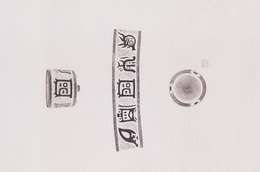 both its content and artistic style.
Ink rubbings have played an important role in recording and preserving Chinese history and culture. They provide valuable historical materials relating to history, geography, politics, economics, military affairs, ethnic groups, folklore, literature, art, science and technology, and architecture. Because many original inscriptions have been damaged or lost over time, surviving rubbings are often essential for studying ancient texts and calligraphy.
In a broad sense, ink rubbing refers to the process of placing paper over an engraved or raised surface and transferring its patterns or characters onto the paper. Rubbings can be made from a wide variety of objects, including oracle bones, bronze vessels, stone tablets, epitaphs, cliff inscriptions, sculptures, coins, and other artifacts. In a narrower sense, the term often refers specifically to reproductions of inscriptions on stone tablets.
The Art of Traditional Rubbing
Traditional Chinese ink rubbing is a highly skilled craft requiring patience, precision, and considerable experience. The main objects traditionally used for rubbing are stone inscriptions, calligraphy, oracle bones, and bronze vessels, although decorative patterns can also be reproduced.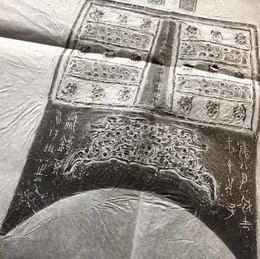
The basic process begins with carefully cleaning the surface of the object. A sheet of suitable xuan paper (rice paper) is then placed over the inscription and lightly moistened. A protective layer of paper may be placed over it, and a soft brush is used to gently tap the paper so that it conforms closely to every raised and recessed detail of the surface.
Once the paper has partially dried and closely adhered to the inscription, the protective paper is removed. Ink is then applied gradually with a rubbing pad or brush. By carefully tapping the ink onto the paper, the raised areas appear dark while the recessed areas remain light, creating the characteristic black-and-white image of an ink rubbing.
When the paper and ink have dried sufficiently, the sheet is carefully removed from the surface. The finished rubbing preserves not only the words or patterns but also many subtle details of the original inscription.
A Living Record of Chinese Civilization
The significance of ink rubbing goes far beyond its function as a traditional craft. For centuries, it has served as an important means of preserving, studying, and transmitting China's written and artistic heritage. Through rubbings, ancient inscriptions that might otherwise have disappeared can continue to be examined by historians, archaeologists, calligraphers, and researchers.
Today, ink rubbing remains both a traditional cultural practice and a valuable method of documenting China's rich heritage. It offers visitors a fascinating glimpse into the techniques through which generations of Chinese people preserved the country's ancient inscriptions and artistic traditions.