Chinese Landscape painting, known as Shan Shui (山水画), literally meaning “mountain-and-water painting,” is one of the most important genres of traditional Chinese painting. It takes mountains, rivers, forests, rocks, clouds, and other elements of the natural world as its principal subjects.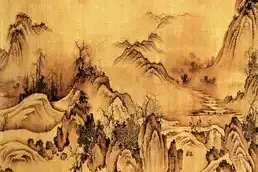
The origins of Shan Shui painting can be traced back to the Wei, Jin, and Northern and Southern Dynasties (220–589), when landscapes were gradually becoming more than merely backgrounds for figure paintings. By the Sui and Tang dynasties (581–907), landscape painting had developed into an independent artistic genre. During the Five Dynasties and Northern Song dynasty (907–1127), it reached a high level of artistic maturity and became one of the central genres of Chinese painting.
Traditionally, Chinese landscape paintings can be classified according to their techniques and use of color into several styles, including blue-and-green landscapes (qinglü shanshui), golden-and-green landscapes, ink landscapes, light-colored landscapes, small blue-and-green landscapes, and boneless landscapes.
The Spirit of Shan Shui Painting
Shan Shui painting represents far more than the visual depiction of mountains and rivers. It embodies the traditional Chinese understanding of the relationship between human beings and nature.
For centuries, Chinese artists and scholars have regarded mountains as symbols of strength, virtue, and stability, while water represents flexibility, vitality, and character. The appreciation of mountains and rivers became closely connected with philosophical reflection, poetry, literature, and the pursuit of spiritual freedom.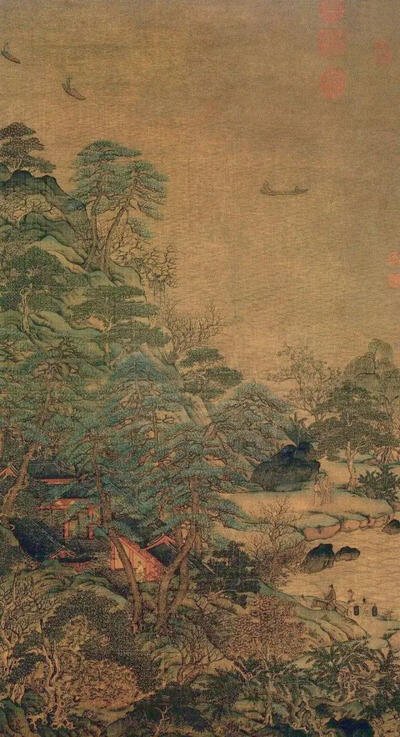
As a result, the beauty of a Shan Shui painting lies not only in its physical resemblance to nature but also in its artistic conception (yijing), atmosphere, rhythm, and spiritual meaning. The painter does not simply reproduce what the eye sees. Instead, the artist seeks to express an inner understanding of nature and the relationship between humanity and the universe.
This is why landscape painting occupies such an important position in Chinese culture. It reflects traditional Chinese people's appreciation of nature, their philosophical outlook, and their pursuit of harmony between humanity and the natural world.
Origins of Chinese Landscape Painting
The development of Shan Shui painting is closely connected with the long history of Chinese art and thought. Long before landscape painting became an independent genre, ancient Chinese people were already expressing their understanding of nature through patterns, carvings, pottery decoration, murals, and rock art.
During the Neolithic period, cultures such as the Hemudu and Yangshao cultures produced artistic motifs that reflected people's observations of animals, plants, agriculture, the seasons, and their surrounding environment. These early forms of artistic expression demonstrate an emerging awareness of the relationship between human society and the natural world.
The development of settled agricultural civilization further strengthened this relationship. As people became increasingly dependent on farmland, rivers, plants, animals, and the changing seasons, nature became an important part of religious beliefs, social life, and artistic expression.
Although these early works cannot be regarded as mature landscape paintings, they laid an important conceptual foundation for the later development of Shan Shui painting.
Qin and Han Dynasties
During the Qin and Han dynasties (221 BC–AD 220), Chinese painting was dominated largely by figures, historical events, religious themes, and scenes associated with imperial and aristocratic life. Landscapes generally appeared as settings or backgrounds for human figures rather than as independent subjects.
Nevertheless, artists gradually developed more sophisticated ways of representing mountains, rivers, buildings, trees, and other elements of the natural environment.
This changing approach reflected a broader transformation in the way people perceived the world. Nature was no longer simply a decorative background. It increasingly became an important subject through which artists could explore space, movement, human experience, and the relationship between humanity and the natural world.
These developments prepared the way for the emergence of landscape painting as an independent genre.
Wei and Jin Dynasties: Landscape Poetry and Painting
The Wei and Jin period (220–420) witnessed an important change in Chinese intellectual and artistic life. Scholars increasingly turned their attention to nature, individual experience, philosophy, and spiritual freedom.
The poet Xie Lingyun (谢灵运) is particularly important in the history of Chinese landscape culture. He is often regarded as one of the earliest major landscape poets. His poetry described mountains, rivers, forests, and changing natural scenery in great detail, demonstrating a growing appreciation of nature as an independent subject of artistic expression.
Another influential figure was Tao Yuanming (陶渊明), whose simple and deeply philosophical poetry expressed a desire for harmony with nature and a life free from worldly pressures.
The development of landscape poetry greatly influenced the evolution of landscape painting. Both forms of art sought to capture not merely the appearance of nature but also its spirit and inner meaning.
The Establishment of Shan Shui Painting
The formal development of Chinese landscape painting is often associated with artists of the Six Dynasties period, particularly Gu Kaizhi (顾恺之).
Gu Kaizhi is best known for his figure paintings, including works traditionally associated with The Admonitions of the Instructress to the Court Ladies and The Nymph of the Luo River. Although these works focus primarily on human figures, their landscapes demonstrate an increasingly sophisticated understanding of mountains, rocks, trees, clouds, and water.
His ideas about painting also contributed to the theoretical development of Chinese landscape art. Rather than treating scenery simply as decoration, artists began to consider how natural elements could be organized to create spatial depth, movement, atmosphere, and artistic conception.
One work associated with Gu Kaizhi, Painting of Yuntai Mountain, is particularly important in discussions of the early development of Chinese landscape painting. Although the original painting has not survived, descriptions and later copies provide evidence of an early attempt to organize mountains, clouds, water, and other natural elements into a coherent landscape composition.
Several important principles can be observed in the development of this early landscape style:
1. The depiction of natural phenomena: Mountains, water, clouds, light, and reflections were increasingly used to convey changes in weather and atmosphere.
2. The arrangement of space: Mountains were organized at different distances and heights to create a sense of depth and grandeur.
3. The balance of visual forces: Different parts of the composition were arranged to create tension, movement, and harmony.
4. The organization of the landscape: Mountains, rivers, trees, and clouds were carefully arranged within a long composition to guide the viewer's eye through the scene.
These developments gradually established the fundamental principles of Chinese landscape painting.
The Artistic Philosophy of Shan Shui
The significance of Shan Shui lies in its ability to unite nature, philosophy, poetry, and painting. Unlike Western landscape painting, which traditionally places considerable emphasis on realistic representation and perspective, Chinese landscape painting often seeks to convey the artist's spiritual response to nature.
A successful Shan Shui painting therefore does not necessarily reproduce an actual mountain or river exactly as it appears. Instead, it presents an idealized vision of nature and expresses the artist's personal understanding of the landscape.
Through mountains and water, Chinese artists explored ideas of harmony, balance, movement, emptiness, distance, and the unity of humanity and nature.
For this reason, Shan Shui has remained one of the most enduring and influential forms of traditional Chinese art. It is not merely a painting of mountains and rivers; it is a visual expression of the Chinese philosophical and aesthetic tradition.
Ancient China Mountain and River painting Schools
Huang School
Also known as "Yellow School of painting", "Huang family wealth". It occupied an important position in the history of Chinese landscape painting. It was one of the two major schools of landscape painting in the Five Dynasties. It was matured in the Five Dynasties and flourished in HuangJu in the early Song Dynasty. Huang Ju Cai had high skills, was good at melting the predecessors of light hook and thick color techniques, was loved by the ruling class as imperial painter. His son Huang Ju and Huang Ju Bao inherited their family traditions and became the dominant landscape faction in the Song Dynasty. The Huang School represented the painting style of Western Shu Kingdom and the Central Plains in the late Tang Dynasty, Five Dynasties and early Song Dynasty, and became the typical style of courtyard landscape painting.
Xu School
Xu School was also one of the two major schools of landscape painting in the Five Dynasties. The representative painter was Xu Xi of the Southern Tang Dynasty. His works payed attention to the outline, light color, revealing natural and unrestrained style. Xus’ brush and ink skills had a great influence on the later generations. When Xu Chongsi, the grandson of Xu Xi, emerged, and the reputation of the Xu Xi School of Painting gradually increased. Later, Zhang Zhong and Wang Ruoshui, Shen Zhou, Chen Daofu, Wen Zhengming and Xu Wei in the Ming Dynasty all developed and finalized this painting style, thus competing with the Huangs Shan Shui painting school, which influenced the Shan Shui landscape painting of the Song, Yuan, Ming and Qing dynasties for thousands of years.
Wu Men School
Wu school was a Chinese painting style in the middle of the Ming Dynasty. Because Suzhou was the ancient capital of Wu Kingdom, it was known as Wu Men, and its main representatives, such as Shen Zhou, Wen Zhengming, Tang Yin, Qiu Ying, Zhang Hong, etc., all belong to Wu County (todays Suzhou), hence the name. The Wumen style of Painting began from Shen Zhou and matured in Wen Zhengming, plus Tang Yin and Qiu Ying, which was the "Four Schools of Wu Men" or "Four Families of Ming Dynasty". After the middle of the Ming Dynasty, the "Wu School" gradually replaced the position of court painting and the "Zhejiang School", which was reproduced in the society, especially among the literati. In the middle and late period of Wu School, social economy was unprecedented, and painting appreciation became a part of peoples life. The status of painters was further improved, and works with strong life atmosphere appeared in the painting world, forming a new look. The representative figures were Wen Jia, Zhang Hong, Zhou Zhiian, Chen Chun, Qiu Zhu, Wen Shu and so on. Different styles, wonderful, for the Wu Men School of painting injected new vitality.
Northern Shan Shui Painting Style
One of the schools of Chinese painting, also known as the "North Shan Shui painting school". At the beginning of the Northern Song Dynasty, Chinese mountain and river painting was divided into northern faction and Jiangnan faction.
Southern Shan Shui Painting Style
The southern landscape painting school is also known as "Jiangnan Landscape Painting School". One of the schools of Chinese painting, Shen Kuo of the Northern Song Dynasty said : " Dong Yuan wrote more about the south of the true mountain, not for the strange gas; Jianye monk is wonderful." Mi Fu in his " Painting History "also said:" Dong Yuan’s painting was plain and naive, no such painting in Tang dynasty." This school regarded Dong Yuan and Ju Ran as their great master. At the end of the Southern Song Dynasty, Fa Chang (Muxi) and Ruofen (Yujian) belonged to the southern painting system and flourished in the Yuan Dynasty.
Huzhou bamboo school
One of the schools of Chinese painting. This school of landscape painting mainly took bamboo forest as the expression object, represented by Song Wentong and Su Shi, especially Wen Tong painting bamboo. Ming Lianru in the Ming Dynasty once wrote Huzhou Bamboo School, and he described that there were 25 painters from the Northern Song Dynasty to the Ming Dynasty. Because Wen Tong had been the governor of Huzhou prefecture (now Zhejiang Wuxing), there it was called so. In the Yuan Dynasty, Zhang zhi believed that painting bamboo began with Li Longji, Emperor Xuanzong of the Tang Dynasty, and Wu Daozi, Wang Wei, Li Ang and Xiao Yue were also good at painting bamboo. Bai Juyi once wrote "Rest in Painting Bamboo" praised. And to the same bamboo art, Wens painted bamboo forest in all his life.
Changzhou school of painting
Also known as the "Piling School of Painting", the "Wujin School of Painting". One of the schools of Chinese painting. Changzhou (now belongs to Jiangsu province), the ancient name of Piling, Wujin, so it was also called "Piling School of Painting", "Wujin School of Painting". This school of painting was based on flowers, grass and insects. Painting flowers, did not use line outline, directly inked with color. His ancestors described the no-bones methods of Xu Chongsi and Zhao Chang in the early years of the Northern Song Dynasty. The Changzhou School of Painting has gathered painters since the Song Dynasty. In the early Southern Song Dynasty, Qingyan and Yu Wudao were famous for painting lotus. In the Ming Dynasty, Sun Long was good at painting freehand flowers and birds. Tang Yuguang in the Qing Dynasty was famous for the "Tang Lotus" and Yun Shoupings "Yun Peony". By the early Qing Dynasty, Changzhou landscape painting has reached its peak.
Mi Pai
One of the schools of Chinese painting. Referred to the paintings painted by Mi Fu and Mi Youren in the Song Dynasty. The history of painting called them "Elder Mi ,Younger Mi". Mi Fu painting was originated from Dong Yuan, and then break through the traditional techniques of hook and Cun, had more ink dye, not to pursue fine. Mi Fu claimed " just casually painted, more to cover trees and stones, sense reached is enough." His son Mi Youren (1074~1153 A.D.), developed Mi Fu’s painting techniques, he used ink horizontal point to write smoke cloud trees, advocated plain naive, drew casually. "Two Mi" were located in Xiangyang and Zhenjiang, particularly intoxicated with the natural scenery of Xiao, Hunan and Jin and Jiao mountains. Therefore, two Mis’ shan shui paintings were mostly themed on mountain, rain and smoke, purely foil with ink, and the "falling eggplant method" showed the beauty of misty rain and fog. It was called "Mi dotting landscape" and "Mis cloud and mountain", which belonged to the big masters of water and ink painting. Muqi in the Southern Song Dynasty, Gao Kegong and Fang Congin the Yuan Dynasty were all respected Mi as teachers, which had a great influence on later generations. And said that this faction was created by Mi Fu, by his son Mi Youren inherited development.
Songjiang school
Also known as the "Songjiang School of Painting". It was the general name for the three shan shui painting school under Songjiang prefecture (now Shanghai ) in the late Ming Dynasty. First, headed by Zhao Zuo, called "Su Song School"; second, headed by Shen Shichong, called "Yunjian School"; third, Gu Zhengyi and his nephews, called "Huating School of Painting".
Zhejiang School
Also known as the "Zhejiang School of painting". One of the schools of Chinese water collar painting. Dai Jin (1388~1462) painting was greatly influenced by Li Tang and Ma Yuan, took the style of the Southern Song Dynasty Painting Academy. He was good at landscape, figures, flowers and fruits, feathers, high painting art, popular for a while, learned from many scholars, gradually formed the "Zhejiang school". Wu Wei (1459~1508), a native of Jiangxia (now Wuchang, Hubei), learned with Dai even more freely. Many people tracked his painting style and formed a tributary of Zhejiang School —— "Jiangxia School". The famous painters of Zhejiang school and Jiangxia School include Zhang Lu, Jiang Sansong, Xie Shuchen, LAN Ying and so on. In the middle of the Ming Dynasty, the Wumen School of painting rose and dominated the painting world. By the end of the Ming Dynasty, the "Zhejiang School" no longer appeared in the painting world.
Huangshan school
Also known as the "Huangshan School of Painting". One of the schools of Chinese painting. In the early Qing Dynasty, Mei family in Xuancheng (now Anhui) were the direct line. They are Mei Qing, Mei Yuzhong, Mei Geng, Mei Fu, and Shi Tao who lived in Xuancheng. Shi Tao Fa in his early years, liked mountains and rivers, and repeatedly visited the scenic spots of Lushan mountain and Huangshan Mountain. For ten years in Xuancheng, he communicated with Mei Shi and Dai Benxiao. These painters, who taught both nature and the ancients, influenced each other and are famous for painting Huangshan, so they are called "Huangshan School". The Xinan School of Painting is mainly from Huangshan, so some people advocate that the Huangshan School of Painting, but the style is different from the "Huangshan School", just as Zhejiang and Cheng Sui have their own characteristics, so some people classify it into the "Huangshan School of Painting", which is really wrong.
Yu shan school
Also known as the "Yushan School of Painting". One of the schools of Chinese painting. Wang Hui, a landscape painter in the Qing Dynasty, studied Wang Jian and Wang Shimin, carefully copied the famous works of the past dynasties, and took the Song and Yuan dynasties to exchange painting skills with Yun Shouping. Emperor Kangxi once ordered him to preside over the giant painting of the "Cruising South Tour" , and gave the book "Shan Shui Qing Hui" four characters, so the reputation of the painting was famous in Kangxi period. His main students include Yang Jin, Gu Fang, Jin Xuejian, etc. Wang Hui was born in Changshu, Jiangsu Province, where Yushan was known as the "Yushan School of Painting". His ancient fashion had a great influence on the Qing Dynasty landscape painting.