Located on a plateau north of Tielumiao Village, about 3 kilometers southeast of downtown Xi’an, Qinglong Temple (Qinglong Si) is one of the most historically significant Buddhist temples in Xi’an. Known as the birthplace of Japanese Shingon Buddhism (Zhenyan Buddhism), the temple played a vital role in cultural and religious exchanges between China and Japan during the Tang Dynasty (618–907 AD).
Although the original temple buildings have undergone many changes throughout history, Qinglong Temple remains an important symbol of the friendship and cultural connection between the two countries.
History of Qinglong Temple
Qinglong Temple was originally established in 582 AD during the Sui Dynasty (581–618 AD) and was first known as Linggan Temple (Temple of Inspiration). The name Qinglong Temple was officially adopted in 711 AD during the Tang Dynasty.
During the early and middle ninth century, many Japanese monks traveled to China to study Buddhism. Among the eight most famous Japanese monks who came to China during the Tang Dynasty, six studied at Qinglong Temple.
The temple became especially famous because of its connection with Kukai (Master Hongfa), one of Japan’s most influential Buddhist figures.
Kukai and the Origin of Japanese Shingon Buddhism
Kukai was born in 774 AD in Sanuki Province (present-day Kagawa Prefecture, Japan). In 804 AD, he traveled to China as part of a Japanese diplomatic mission led by Fujiwara Kadzunomaro to study Buddhism and Chinese culture.
At Qinglong Temple, Kukai studied under Master Hui Guo, a renowned Tang Dynasty Buddhist master of the Esoteric Buddhism (Mizong) tradition.
According to Buddhist tradition, Master Hui Guo accepted Kukai as his disciple through an important initiation ceremony, pouring holy water over his head and giving him the Buddhist title Bian Zhao Jin Gang (Universal Radiance Vajra). Through this ceremony, Kukai became the eighth-generation master of Esoteric Buddhism.
Master Hui Guo also arranged for Buddhist scriptures, religious paintings, and ritual instruments to be prepared for Kukai. Despite studying for less than two years, Kukai mastered the teachings and returned to Japan.
 Kukai’s Contributions to Japan
After returning to Japan, Kukai founded the Shingon Sect (True Word School) and established the famous Buddhist center at Mount Koya (Koyasan).
Beyond Buddhism, Kukai made significant contributions to Japanese culture, education, and art.
He was:
* A highly accomplished Buddhist scholar
* A master calligrapher
* An educator
* A writer and cultural innovator
Kukai was especially famous for his calligraphy skills. Together with Emperor Saga and Tachibana no Hayanari, he was recognized as one of the Three Great Calligraphers of Japan.
His calligraphy work “Fushinjo” is regarded as a masterpiece and a national treasure of Japan.
Cultural Achievements of Kukai
Kukai’s influence extended far beyond religion. He wrote many important works covering Buddhism, literature, language, and calligraphy, including:
* Bunkyohifuron – an important study of Tang Dynasty poetry
* Tenreibansho Meigi – considered the first Chinese-character dictionary in Japan
* Shorihosho – one of Japan’s earliest works on Chinese calligraphy
He also contributed to the development of Japanese writing. By studying Chinese cursive script, Kukai helped establish the foundation of hiragana, the Japanese phonetic writing system still used today.
In addition, he introduced Chinese technologies and knowledge to Japan, including:
* Irrigation techniques
* Brush-making methods
* Buddhist texts and artworks
* Chinese calligraphy traditions
Through these achievements, Kukai greatly strengthened cultural exchange between China and Japan during the Tang Dynasty.
Qinglong Temple Today
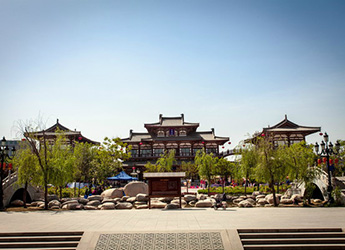
A monument commemorating Kukai was erected at Qinglong Temple in 1982. The temple halls have since been restored, allowing visitors to explore this historic Buddhist site.
Today, Qinglong Temple is not only a place of religious significance but also an important cultural attraction in Xi’an. It represents the close historical relationship between China and Japan and offers visitors a chance to learn about the international influence of Tang Dynasty civilization.
The temple is also famous for its beautiful seasonal scenery, especially its cherry blossoms, which attract visitors every spring.