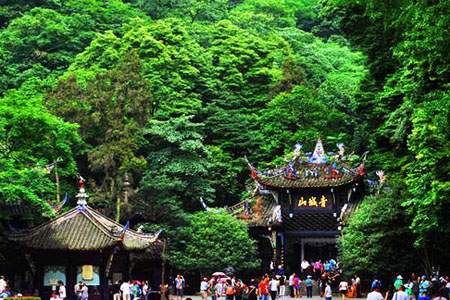
Lishan Mountain Forest Park (骊山国家森林公园) is one of the most famous scenic areas near Xi’an, Shaanxi Province. As a northern branch of the Qinling Mountains, Lishan stretches for more than 20 kilometers from east to west and reaches an altitude of 1,256 meters.
Located approximately 30 kilometers from downtown Xi’an, Lishan Mountain is renowned for its beautiful landscapes, ancient legends, and rich historical heritage. From a distance, the mountain resembles a magnificent galloping horse, which has inspired countless poems, stories, and folk legends throughout Chinese history.
Combining natural scenery with cultural landmarks, Lishan Mountain is an ideal destination for travelers seeking history, mythology, and panoramic views of Xi’an.
A Historic Mountain with Deep Cultural Roots
Lishan Mountain has been regarded as a sacred place for centuries and is closely connected with Chinese mythology, Taoism, and imperial history.
The mountain is home to many historical sites and ancient structures, including the famous Laojun Palace and the remains of the Huaqing Palace complex.
According to Taoist tradition, Laojun Palace was associated with Laozi, the founder of Taoism, and was once an important place for religious worship. The site reflects the long-standing influence of Taoist culture in the Xi’an region.
Connection with Huaqing Palace
At the foot of Lishan Mountain lies the renowned Huaqing Palace, an imperial resort famous for its hot springs and romantic legends.
Built and expanded by several Chinese dynasties, Huaqing Palace was especially favored by Tang Dynasty emperors. The most famous story connected with the palace is the romance between Emperor Xuanzong of Tang and Yang Guifei, one of the Four Beauties of ancient China.
The combination of Lishan Mountain and Huaqing Palace creates one of the most historically significant cultural landscapes near Xi’an.
Bingjian Pavilion and the Xi’an Incident
Another important landmark on Lishan Mountain is Bingjian Pavilion, built in memory of the historic Xi’an Incident of 1936.
On December 12, 1936, Chinese generals Zhang Xueliang and Yang Hucheng launched the Xi’an Incident, during which they detained Chiang Kai-shek in an effort to persuade different political forces to unite against the Japanese invasion.
The event became a turning point in modern Chinese history and played an important role in shaping the country’s political development during the 20th century.
Today, Bingjian Pavilion serves as a historical site where visitors can learn about this important event.
Spectacular Views from Lishan Mountain
Beyond its historical significance, Lishan Mountain is also famous for its natural beauty.
The mountain features:
* Dense forests and fresh mountain air
* Beautiful valleys and scenic trails
* Panoramic views of Xi’an and the surrounding countryside
* Stunning sunrises and sunsets
Standing on the summit of Lishan Mountain, visitors can enjoy breathtaking views while experiencing the peaceful atmosphere of this ancient landscape.
Why Visit Lishan Mountain?
Lishan Mountain offers a perfect combination of nature, history, and culture. From Taoist legends and imperial stories to modern historical events, the mountain preserves memories from different periods of Chinese civilization.
For travelers exploring Xi’an, a visit to Lishan Mountain provides a chance to escape the city, enjoy spectacular scenery, and discover one of the most culturally significant mountains in Shaanxi Province.