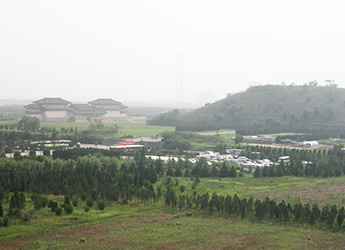
Located about 30 kilometers north of downtown Xi’an and approximately 20 kilometers from Xi’an Xianyang International Airport, Hanyang Mausoleum is one of the most important archaeological sites of the Western Han Dynasty (206 BC–AD 9). It is the burial complex of Emperor Jingdi (188–141 BC), the fourth emperor of the Han Dynasty, and is famous for its large collection of exquisite Han Dynasty terracotta figurines and animal sculptures.
Opened to the public in 2001, Hanyang Mausoleum has become one of the most fascinating historical attractions around Xi’an. Unlike the famous Terracotta Warriors of Qin Shi Huang, the underground burial treasures here reveal a different aspect of ancient Chinese history, focusing on the peaceful and prosperous lifestyle of the Han Dynasty.
History of Emperor Jingdi and Hanyang Mausoleum
Emperor Jingdi, whose personal name was Liu Qi, ruled during a golden period of the Western Han Dynasty. Together with his father Emperor Wen, he introduced policies of economic recovery, social stability, and reduced taxation, creating the prosperous era known as the “Rule of Wen and Jing.”
Construction of Hanyang Mausoleum began after Emperor Jingdi’s death and followed the traditional imperial burial system of the Han Dynasty.
Although the emperor’s main underground tomb has not been opened, visitors can explore the surrounding burial pits where thousands of precious artifacts have been discovered.
Layout of Hanyang Mausoleum
Hanyang Mausoleum is a large imperial burial complex protected as a national cultural heritage site. The site includes:
* Emperor Jingdi’s tomb
* Empress Wang’s tomb
* Southern and northern burial pits
* Ceremonial areas
* Human sacrifice burial sites
* Criminals’ cemetery
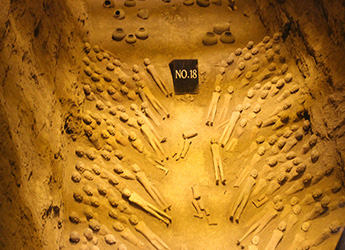
The most famous part of the site is the Outer Burial Pits Exhibition Hall, which opened in 2006 and became the first underground museum in China.
 Underground Museum Experience
The underground exhibition hall is the highlight of Hanyang Mausoleum and offers visitors a unique archaeological experience.
Unlike traditional museums where artifacts are displayed behind glass cases, visitors here can stand above a large glass floor and look directly into the underground excavation area. From above, they can observe the original archaeological environment and watch researchers and workers carefully studying the relics without disturbing them.
This innovative design creates a rare connection between visitors and archaeology, allowing people to experience how ancient sites are discovered and preserved.
Han Dynasty Terracotta Figurines
The most valuable discoveries from Hanyang Mausoleum are the large number of terracotta figurines and animal sculptures found in the burial pits.
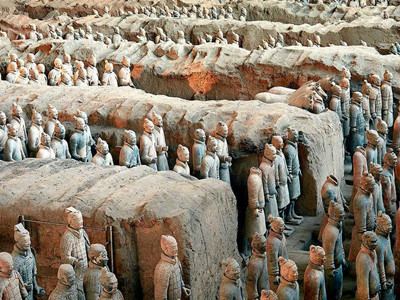
Unlike the life-sized warriors of Qin Shi Huang’s Terracotta Army, the Hanyang figurines are smaller, more delicate, and often represent everyday life in the Han Dynasty.
The collections include:
* Terracotta soldiers
* Officials
* Court attendants
* Musicians
* Animals such as horses, sheep, and dogs
Many figurines originally had movable wooden arms and colorful painted surfaces, providing important information about Han Dynasty clothing, military organization, social customs, and artistic techniques.
Interactive Archaeology Experience
One of the most attractive features of Hanyang Mausoleum is its simulation archaeology program.
With advance booking and an additional fee, visitors can participate in a simulated archaeological excavation experience. Under professional guidance, participants can learn about excavation methods and experience the work of archaeologists.
This program makes Hanyang Mausoleum especially popular among families, students, and visitors interested in history and archaeology.
A Hidden Gem Near Xi’an
Compared with the more famous Terracotta Warriors, Hanyang Mausoleum receives fewer visitors and offers a quieter cultural experience. Many travelers consider it a hidden gem near Xi’an, where they can explore Han Dynasty history in a more immersive and relaxed environment.
With its underground museum, fascinating terracotta collections, and innovative archaeological displays, Hanyang Mausoleum provides a unique opportunity to understand the civilization, customs, and achievements of the Western Han Dynasty.