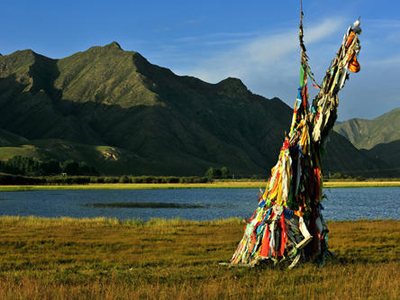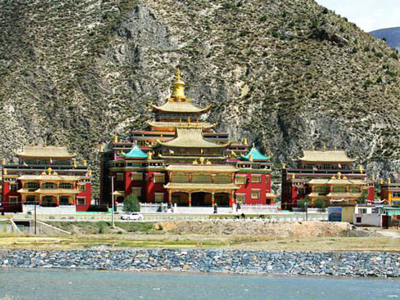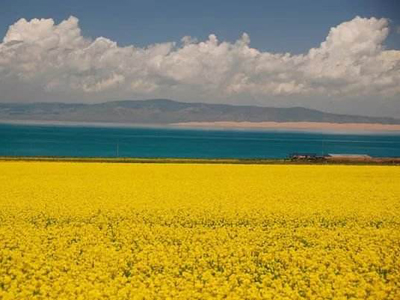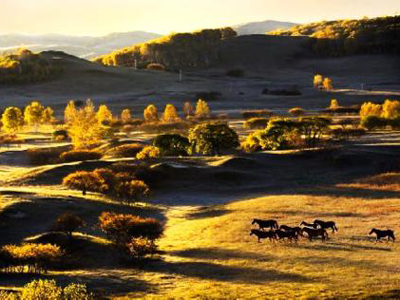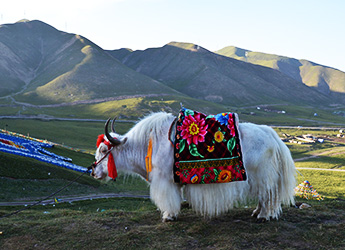
Riyue Mountain (Sun and Moon Mountain) is one of the most famous cultural and natural landmarks in Qinghai Province, China. Located about 40 kilometers from Huangyuan County, west of Xining City, the mountain stands at an average elevation of around 4,000 meters and serves as an important geographical and historical boundary on the Qinghai-Tibet Plateau.
Known as a “natural dividing line” in China, Riyue Mountain separates:
* The Loess Plateau and the Qinghai-Tibet Plateau
* Agricultural regions and nomadic grasslands
* The monsoon climate zone and the non-monsoon climate zone
With its dramatic landscape transition, Riyue Mountain offers visitors a rare opportunity to witness two completely different worlds on opposite sides of the same mountain.
A Natural Boundary Between Two Landscapes
Standing on Riyue Mountain, visitors can clearly observe the contrast between eastern and western Qinghai.
On the eastern side, fertile farmland spreads across the valley, creating a beautiful pastoral scene with villages, crops, and cultivated fields.
On the western side, endless grasslands stretch toward the horizon, where herds of sheep and cattle roam freely across the high plateau.
This sharp change from farming landscapes to vast nomadic grasslands makes Riyue Mountain one of the most unique scenic spots in Qinghai.
Riyue Mountain in History
Throughout history, Riyue Mountain has been an important transportation route connecting central China with the western frontier regions.
During the Northern Wei Dynasty (386–534), the Buddhist monk Song Yun traveled through this area on his journey from Luoyang to India to study Buddhism.
The mountain became even more famous during the Tang Dynasty when Princess Wencheng passed through Riyue Mountain on her journey to Tibet to marry King Songtsen Gampo of the Tubo Kingdom in 641 AD.
Since then, Riyue Mountain has become a symbol of cultural exchange between the Han Chinese and Tibetan peoples.
The Legend of Princess Wencheng and Riyue Mountain
According to local legend, Riyue Mountain was originally called Chiling Mountain (Russet Ridge) during the Tang Dynasty because of its reddish-brown, grassless peaks.
When Princess Wencheng reached the mountain on her way to Tibet, she took out a precious Sun and Moon Treasure Mirror given by her mother. Through the mirror, she saw her hometown Chang’an (today’s Xi’an) and felt deep homesickness.
However, she understood her responsibility to promote peace and friendship between the Tang Dynasty and Tibet. She threw the mirror onto the mountain, and legend says:
* The mirror transformed into Qinghai Lake
* Her tears became the Daotang River, a river that flows westward
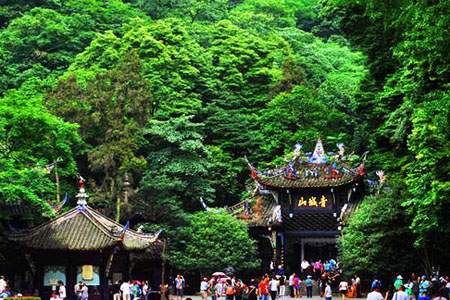
The mountain was later named Riyue Mountain (Sun and Moon Mountain), and two pavilions were built at the mountain pass to commemorate Princess Wencheng:
* Sun Pavilion (Ri Pavilion)
* Moon Pavilion (Yue Pavilion)
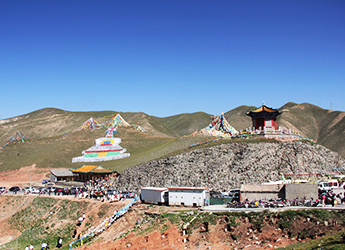 Sun Pavilion and Moon Pavilion
The Sun Pavilion and Moon Pavilion are the cultural symbols of Riyue Mountain.
The Moon Pavilion especially highlights the historical contributions of Princess Wencheng, who, according to tradition, brought important cultural exchanges to Tibet, including:
* Agricultural knowledge
* Crop seeds
* Medical knowledge
* Buddhist teachings
* Advanced technologies
These stories have made Riyue Mountain an important symbol of friendship and cultural communication between different ethnic groups.
Best Time to Visit Riyue Mountain
The best season to visit Riyue Mountain is from June to September.
During summer and early autumn:
* The grasslands become green and vibrant
* Wildflowers bloom across the plateau
* The weather is pleasant for sightseeing
* The surrounding scenery is at its most beautiful
Visitors can enjoy spectacular views of:
* Snow-covered mountains
* Endless grasslands
* Herds of livestock
* Traditional Tibetan plateau landscapes
Travel Experience at Riyue Mountain
A visit to Riyue Mountain allows travelers to experience both natural beauty and cultural history.
Highlights include:
* Viewing the dramatic landscape transition between farmland and grassland
* Visiting the Sun and Moon Pavilions
* Learning about Princess Wencheng’s legendary journey
* Exploring Tibetan plateau scenery
* Experiencing the culture of Qinghai’s ethnic communities
For travelers exploring Xining, Qinghai Lake, and the Qinghai-Tibet Plateau, Riyue Mountain is an essential stop that combines history, legend, and breathtaking scenery.