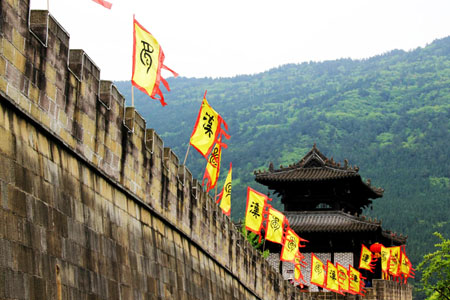
 Located in Chibi City, Hubei Province, Chibi Ancient Battlefield (also known as Stone Pass) is one of the most famous historical sites in China. It is the legendary location of the Battle of Red Cliff (Chibi Battle), one of the most important battles during the Three Kingdoms period (220–280 AD).
The scenic area is composed of three mountains: Chibi Mountain, Nanping Mountain, and Jinluan Mountain. According to historical records and local legends, the famous Chinese characters “赤壁” (Chibi, meaning “Red Cliff”) were carved on the cliff by people inspired by the heroic events of the Three Kingdoms era. Today, Chibi remains a popular destination for travelers interested in Chinese history, culture, and ancient battlefields.
The Legendary Battle of Red Cliff
In AD 208, warlord Cao Cao led a powerful army, reportedly numbering hundreds of thousands of soldiers, southward in an attempt to defeat his rivals and unify China under his rule. After defeating Liu Bei’s forces, Cao Cao continued his campaign toward the Kingdom of Wu in the east.
Facing a serious threat, Liu Bei sent his strategist Zhuge Liang to form an alliance with Sun Quan, ruler of Eastern Wu. The two sides joined forces to resist Cao Cao’s army.
The allied forces of Liu Bei and Sun Quan achieved a remarkable victory at Chibi by using fire attacks against Cao Cao’s navy. The flames turned the rocks along the riverbank red, giving the battlefield its famous name — Chibi, meaning “Red Cliff” in Chinese.
The Battle of Red Cliff became one of the most celebrated military victories in Chinese history and played a decisive role in shaping the Three Kingdoms period.
Main Attractions of Chibi Ancient Battlefield
Chibi Cliffside Inscriptions
The Chibi Cliffside Inscriptions are among the most iconic attractions in the scenic area. On the riverside cliff of Chibi Mountain, two large Chinese characters, “赤壁” (Chibi), are carved into the stone.
Each character measures approximately 1.5 meters high and 1.04 meters wide. Although exposed to thousands of years of wind, rain, and river waves, the inscriptions remain clear and well preserved, attracting visitors who appreciate ancient Chinese calligraphy and history.
Yijiang Pavilion
Located on a riverside rocky outcrop of Chibi Mountain, Yijiang Pavilion was built in 1936. The pavilion features traditional architectural elements, including glazed roof tiles, six supporting pillars, and a tower-shaped roof decoration.
The name of the pavilion comes from the legend that Chibi Mountain and Iron Mountain resemble the two wings of the mythical Kunpeng bird, creating a unique landscape along the Yangtze River.
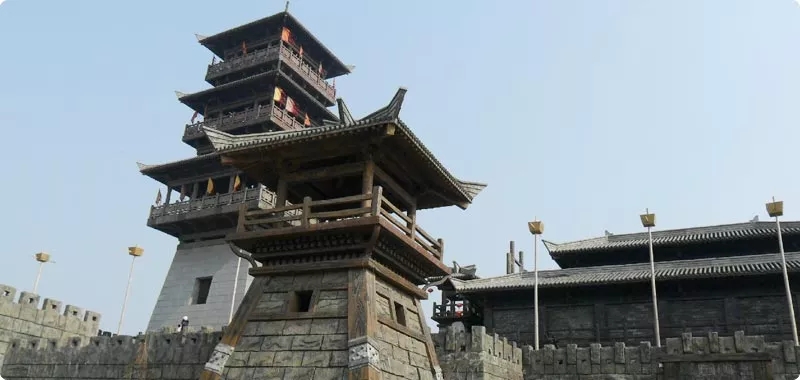 Wind-Praying Altar (Wuhou Palace)
The Wind-Praying Altar, also known as Wuhou Palace, is located on the top of Nanping Mountain southeast of Chibi Mountain.
According to legend, this was the place where Zhuge Liang, the famous strategist of Shu Han, prayed for the east wind that helped Zhou Yu launch the successful fire attack during the Battle of Red Cliff.
Covering an area of about 310 square meters, the palace consists of two temples. Inside, visitors can see lifelike statues of Liu Bei, Guan Yu, Zhang Fei, and Zhuge Liang, dressed in traditional robes.
Stone Statue of Zhou Yu
On a flat area of the Chibi Mountain rocky outcrop stands a magnificent stone statue of Zhou Yu, the famous commander of Eastern Wu during the Three Kingdoms period.
The statue is 9 meters high and is considered the largest stone statue of a historical figure in Hubei Province. It commemorates Zhou Yu’s important role in leading the allied forces to victory at the Battle of Red Cliff.
Fengchu Hut
Located on Jinluan Mountain southeast of Nanping Mountain, Fengchu Hut is associated with Pang Tong, one of the most famous strategists of the Three Kingdoms period. Pang Tong was also known as Mr. Fengchu (“Young Phoenix”).
According to legend, this was the place where Pang Tong studied military strategies during the Chibi War. The current building was rebuilt during the 26th year of the Daoguang Emperor’s reign in the Qing Dynasty (AD 1846).
The hall covers an area of about 300 square meters and consists of three sections:
* The first hall houses a statue of Pang Tong.
* The second hall serves as the Chibi Library.
* The third hall functions as a reception area and restroom.
Chibi Gallery of Steles
The Chibi Gallery of Steles is located beside the Wind-Praying Altar and behind the East-wind Pavilion. Construction began in 1985, and the gallery was officially opened to visitors in May 1986.
Covering approximately 277 square meters, the gallery is a traditional-style corridor built with reinforced concrete, wood, and stone.
Inside the gallery are 25 stone steles featuring poems and writings about the Battle of Red Cliff by famous poets from different dynasties. These inscriptions are created in various Chinese calligraphy styles, including running script, cursive script, seal script, and clerical script, representing valuable works of Chinese cultural heritage.
Visit Chibi Ancient Battlefield
With its dramatic landscapes, ancient inscriptions, and legendary stories of Cao Cao, Zhuge Liang, Liu Bei, Sun Quan, and Zhou Yu, Chibi Ancient Battlefield offers visitors a unique opportunity to experience one of China’s greatest historical events.
For travelers interested in Three Kingdoms history, Chinese culture, ancient warfare, and historical landmarks, Chibi is an unforgettable destination that brings centuries-old legends back to life.