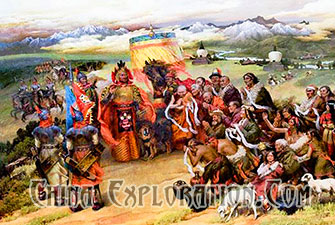
The Epic of King Gesar is one of the world's great heroic epics and an important part of Tibetan oral and cultural heritage. Its origins are traditionally associated with the early centuries of the first millennium, when conflicts among clans, tribes, and ethnic groups were frequent. These struggles provided much of the historical and cultural background from which the epic developed.
During the heyday of the Tubo (Tibetan) Kingdom, from the 7th to the 9th centuries, Tibetan society experienced significant political, economic, and cultural development. Against this historical background, stories about Gesar gradually spread and were passed down through generations of storytellers and singers.
The epic became popular throughout Tibetan-inhabited areas of China, particularly in Tibet, Sichuan, Qinghai, Gansu, and Yunnan. It also spread among the Mongolian, Tu, and Yugur peoples. Although these communities were separated by vast distances and difficult terrain, traditional singers preserved remarkably similar stories and characters. Versions of the epic can also be found among Mongolian and Tibetan communities outside China.
Becoming the King
Traditional versions of the epic often begin with chapters concerning Heaven, the Birth of the Hero, and Gesar's Rise to Kingship through a Horse Race. These stories describe Gesar's divine origins, childhood, and eventual rise to become the king of the State of Ling.
Long ago, the ancestors of the Tibetan people lived peacefully until warfare suddenly broke out across the region. Seeing the suffering of the people, the Goddess of Mercy appealed to Amitabha Buddha for help. Amitabha sent a divine hero to the human world to rescue the people from suffering. This hero became Gesar.
The epic portrays Gesar as a legendary hero with both divine and human qualities. From his birth, he faced persecution and hardship, but with his own courage and strength, together with the protection of various deities, he eventually overcame demons and other powerful enemies.
When Gesar was five years old, he and his mother moved to the region of the Yellow River. Several years later, the Ling tribe also migrated there. A horse race was organized to determine the future king of Ling, with the winner also to marry Zhubmo, one of the most beautiful women of the tribe.
Gesar entered the competition and defeated his uncle and numerous other contestants. After winning the race, he became king of Ling and was given the title Gesar Lhogyal, the Lion King of the World.
Subduing the Demons
After ascending the throne, King Gesar faced a series of powerful enemies. The central part of the epic recounts his campaigns against four major kingdoms: Mo, Hor, Jiang, and Moin.
To the north of Ling lay the State of Mo, ruled by King Lutsang, a cruel ruler portrayed in the epic as a demon who preyed upon children. Lutsang kidnapped Maisa, one of Gesar's consorts. Gesar traveled north to rescue her and eventually defeated the demon king.
However, Maisa wished to become Gesar's principal wife rather than remain a consort in Ling. Through a magical potion, she caused Gesar to remain in Mo for twelve years. During his absence, the State of Ling was invaded by Hor, and Gesar's wife Zhubmo was captured.
The State of Hor lay to the northeast of Ling and was ruled by three brothers known as the Yellow Tent King, White Tent King, and Black Tent King, named after the tents in which they lived. The White Tent King was the most powerful of the three.
After hearing of Zhubmo's beauty, the White Tent King launched an invasion of Ling with the help of traitors within the kingdom. He captured Ling and took Zhubmo away.
When Gesar finally awoke from the magical spell, he returned to Ling and fought the invaders. In the ensuing battle, he defeated and killed the White Tent King and rescued Zhubmo.
To the southeast of Ling lay the State of Jiang, ruled by King Sadain, a greedy sorcerer who sought to seize Ling's salt-producing lands. Gesar sent his general Sinba to win over Sadain's son, Yulha Toju, while he himself defended the salt fields.
With Yulha Toju's assistance, Gesar learned about Sadain's plans. According to the epic, Gesar eventually transformed himself into a tiny golden fish, which Sadain swallowed. Once inside Sadain's body, Gesar transformed again, eventually forcing the sorcerer to surrender.
The State of Moin was another longstanding enemy of Ling. Its forces had repeatedly raided and plundered Ling when the kingdom was weak. After Gesar had defeated several other demons, Sinchi, king of Moin, remained his most powerful enemy.
Gesar decided to defeat Sinchi and, at the same time, marry his beautiful daughter Meido Zholma. After a fierce battle in which both sides suffered heavy losses, Gesar personally confronted Sinchi and finally shot him dead.
With the four major enemies defeated, peace returned to Ling and its neighboring kingdoms.
Returning to Heaven
Gesar's adventures did not end with the defeat of the four great enemies. He continued to fight wars to defend Ling and to assist neighboring kingdoms threatened by powerful rulers.
When Gesar's uncle stole horses from the State of Dashi, conflict broke out between the two kingdoms. Gesar led his forces to victory and, according to the epic, distributed Dashi's wealth among the people before returning to Ling.
Later, Chidain, king of the State of Kachi, conquered Nepal, Korgas, and several other smaller kingdoms before launching an invasion of Ling. Gesar defeated Chidain and again distributed his wealth among the people.
Further campaigns followed, either to defend Ling's homeland or to assist neighboring states that had been invaded. Gesar emerged victorious from these battles, and the State of Ling gradually grew into a powerful kingdom.
Having completed his mission in the human world, Gesar eventually returned to heaven together with his mother and wife Ngada Lhamo.
This marks the traditional conclusion of The Epic of King Gesar, a monumental body of oral literature that has been preserved for centuries through the performances of Tibetan, Mongolian, and other ethnic storytellers and singers.