The Dong people are one of China's ethnic minority groups. They traditionally live mainly in the mountainous areas of Guizhou, Hunan, and Guangxi, with the largest communities concentrated in southeastern Guizhou. Their culture is particularly well known for its distinctive architecture, traditional costumes, polyphonic singing, and rich festival traditions.
Traditional Dong Clothing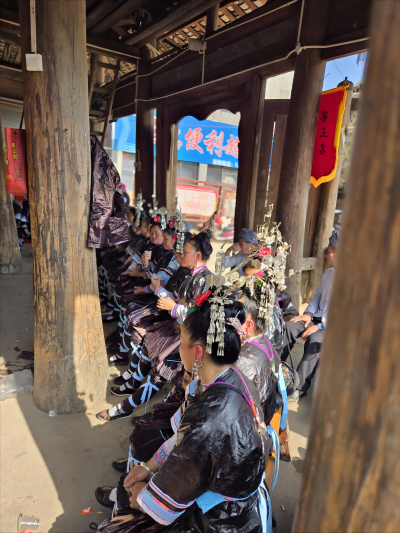
In the past, Dong clothing was generally handwoven and naturally dyed by local people. Traditional costumes varied according to age, season, region, and social occasion. Clothing and accessories included garments, trousers and skirts, headwear, necklaces, chest ornaments, waist decorations, bracelets, and other forms of personal adornment.
Traditional Dong clothing commonly features blue, black, and white. Women's costumes are especially elaborate, with silver ornaments playing an important role. Traditional headwear includes silver crowns, hairpins, combs, hair chains, earrings, and other ornaments.
There are numerous regional styles of Dong women's hairstyles. Hair may be arranged in buns, braids, or other elaborate forms, with distinctive styles associated with particular communities. When dressed in traditional festival clothing, Dong women can appear especially striking because of the combination of colorful textiles and shimmering silver ornaments.
Dong Villages and Architecture
Dong villages are generally located in beautiful mountain environments, often surrounded by forests, rivers, streams, and terraced fields. Villages may be built along rivers or on steep slopes, with houses adapted to the local terrain.
Traditional Dong houses are often stilted wooden buildings. The upper floors are used as living spaces, while the lower levels may be used for keeping livestock or storing agricultural materials.
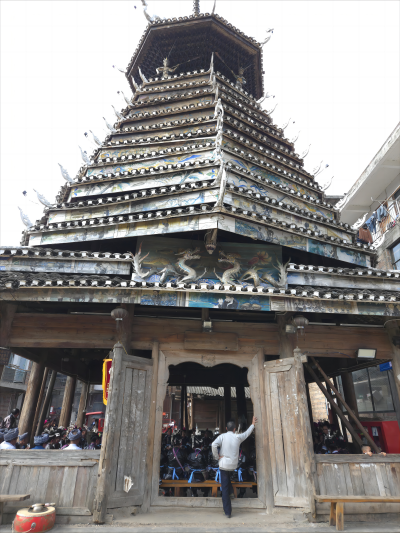
The most distinctive structure in a Dong village is the Drum Tower (Gulou). Usually constructed entirely of wood, a traditional Drum Tower has multiple projecting roofs and elaborately layered eaves. Most have a square ground plan, although some are hexagonal.
The lower part of the tower is the main communal space. It may contain a central fire pit surrounded by benches, providing a place where villagers gather, talk, sing, tell stories, play musical instruments, and conduct community activities.
The Drum Tower is far more than an architectural landmark. It is an important community center and symbol of Dong culture. Traditionally, villagers gathered there to discuss village affairs, establish community rules, mediate disputes, welcome guests, celebrate festivals, and organize other important activities.
Dong Music and Singing
Singing occupies a central place in Dong social and cultural life. Traditional songs are transmitted orally from one generation to another. Older people teach songs to younger generations, while young singers learn and perform them at festivals and community gatherings.
Among the best-known forms of Dong music are Dong Grand Choirs (Dong Dage), pipa music, and traditional antiphonal or “blocking-the-road” songs.
The Dong Grand Choirs are particularly famous for their sophisticated polyphonic structure. A lead singer may begin a passage, followed by a chorus singing several complementary vocal lines. The music traditionally features multiple vocal parts without instrumental accompaniment.
The complexity and beauty of this traditional polyphonic singing have earned Dong Grand Choirs the reputation of being the “sound of heaven.” Dong songs are not simply entertainment; they also preserve historical memories, moral values, local knowledge, stories, and traditional ways of life.
 Festivals of the Dong People
The Dong people have a remarkably rich festival calendar. Different communities celebrate different festivals, and some are shared throughout the Dong region while others belong only to a particular village, clan, or family.
Dong festivals are associated with many aspects of traditional life, including the agricultural seasons, harvests, ancestor worship, religious beliefs, local heroes, family and clan traditions, courtship, entertainment, and sporting activities.
Music and singing are particularly important during festivals. Villagers dress in traditional costumes, welcome visitors, organize communal activities, and perform traditional songs. In many communities, festivals provide an important opportunity for young people to meet, socialize, and express their affection through traditional singing.
Dong Culture Today
The combination of wooden architecture, Drum Towers, covered bridges, traditional costumes, silver ornaments, polyphonic singing, and vibrant festivals makes Dong culture one of the distinctive cultural traditions of southwestern China.
Dong villages remain especially attractive to visitors because their architecture and natural surroundings form an integrated cultural landscape. At the same time, Dong songs and traditional festivals continue to serve as important ways of preserving the community's history, identity, and cultural heritage for future generations.