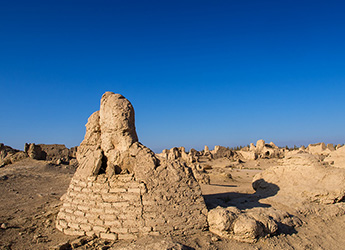
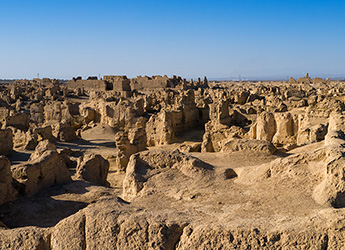
 Located about 10 kilometers west of Turpan City, the Jiaohe Ruins are widely regarded as one of the most impressive historical attractions in Xinjiang. Built on a natural earthen plateau between two rivers, this ancient city is considered one of the best-preserved ruins of its period in China and is often regarded by travelers as the highlight of a visit to Turpan.
Unlike the nearby Gaochang Ancient City, which suffered more destruction over centuries, Jiaohe remains remarkably intact because its isolated location made farming, rebuilding, and material removal extremely difficult.
Unique Geographic Setting
The name Jiaohe (交河) means “the meeting of two rivers” in Chinese, referring to the two waterways surrounding the ancient city.
The ruins stand on a narrow natural plateau, or river island, measuring approximately:
* 1.6 kilometers long
* 300 meters wide at its widest point
The plateau is surrounded by deep canyons about 20–30 meters high, with steep cliffs providing natural protection.
Because there was no surface water or Karez irrigation system on top of the plateau, agriculture was difficult and later communities had little reason to occupy or destroy the site. This helped preserve Jiaohe’s ancient structures for centuries.
Layout and Architecture of Jiaohe Ancient City
The people of Jiaohe created their city by carving directly into the natural earth plateau and building with rammed earth and dried bricks. Many structures were formed by digging down into the ground rather than constructing upward.
The city had a carefully planned layout:
* A central avenue divided the city into eastern and western sections.
* The western area was mainly residential.
* The eastern area was occupied by government buildings and elite residences.
* The northwest area contained Buddhist temples, stupas, and religious structures.
* A cemetery and underground temple were located at the northern end.
The city is believed to have had only two main gates:
* A southwestern gate
* An eastern gate
For a city of this size, having so few entrances was unusual and reflects its naturally defensive location.
One of the most remarkable surviving structures is the large Buddhist monastery and tower complex in the northwest section, which provides important evidence of the city’s religious importance during the Silk Road period.
History of Jiaohe Ruins
The history of Jiaohe dates back more than 2,000 years.
Archaeological discoveries near the site include tombs dating to around 300 BC, where remains believed by some scholars to belong to Caucasian populations were found. The earliest inhabitants were associated with the ancient Gushi (Jushi) people, who established the settlement known as Cheshi.
During the Han Dynasty (206 BC–220 AD), China expanded its influence into Central Asia. Around 60 BC, the Cheshi people came under Han control, and the region became an important strategic point for protecting Silk Road trade routes.
Later, control of the area changed among different kingdoms until the Tang Dynasty (618–907). In 640 AD, the Tang Empire conquered Gaochang and strengthened its control over the Turpan Basin.
Most of the remaining structures at Jiaohe date from the Tang Dynasty period. At its peak in the 8th century, the city is believed to have had a population of around 7,000 people.
Decline of Jiaohe
After the fall of the Tang influence in Central Asia, the region became controlled by the Uyghurs. Around 1209, the Uyghurs submitted to Genghis Khan and became part of the expanding Mongol Empire.
By the middle of the 14th century, several factors contributed to Jiaohe’s abandonment:
* Decline of Silk Road trade
* Regional conflicts and instability
* Changes in climate conditions
* Reduced availability of water resources
Eventually, the once-thriving Silk Road city became a deserted archaeological site preserved in the desert landscape.
Visiting Jiaohe Ruins
Today, visitors can walk among the remains of ancient streets, residential areas, temples, and government buildings while imagining the life of a Silk Road city more than a thousand years ago.
Highlights include:
* Ancient city streets and residential ruins
* Buddhist temple remains
* Large earthen buildings
* Views over surrounding desert valleys
* Photography of the unique canyon landscape
With its extraordinary preservation, dramatic desert setting, and rich Silk Road history, Jiaohe Ruins is one of the must-see attractions in Turpan and one of the most fascinating ancient cities in Xinjiang.