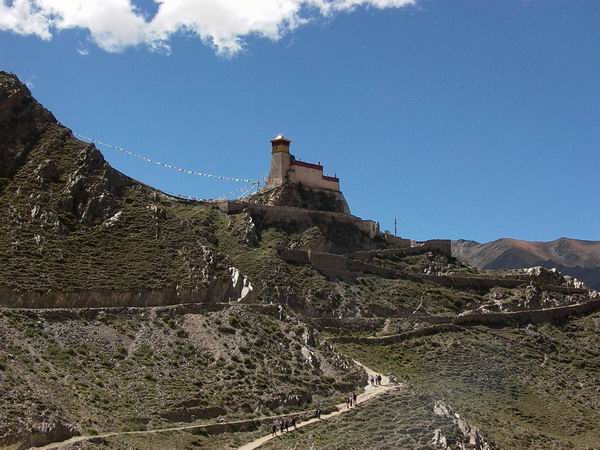
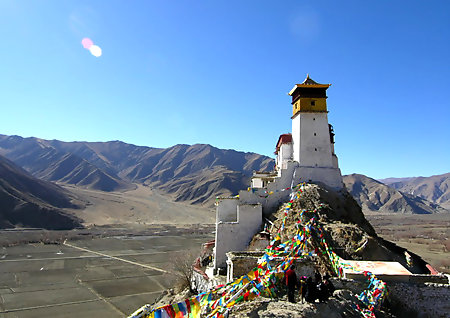
Perched dramatically on the summit of Jormo Zhaxi Ceri Mountain on the eastern bank of the Yarlung River, Yumbulagang (also spelled Yumbu Lhakhang) is one of the most historically significant landmarks in Tibet. Known as the first palace in Tibet, this ancient structure has a history of more than 2,000 years and represents the origins of Tibetan royal civilization.
With its fortress-like appearance, sacred legends, and panoramic views over the Yarlung Valley, Yumbulagang is one of the most important cultural attractions in southern Tibet.
History of Yumbulagang Palace
The name Yumbulagang comes from Tibetan words:
* “Yumbu” refers to a female deer, inspired by the shape of Jormo Zhaxi Ceri Mountain, which resembles a resting doe.
* “Lagang” means a sacred palace or temple.
Together, Yumbulagang means the “Palace of Mother and Son.”
According to Tibetan historical tradition, Yumbulagang was built in the 2nd century BC for Nyatri Tsenpo, the first king of Tibet. Later, it became a royal residence for famous Tibetan rulers, including Songtsen Gampo and Princess Wencheng of the Tang Dynasty.
After the rise of Tibetan Buddhism, the palace gradually changed from a royal residence into a Buddhist monastery. During the time of the Fifth Dalai Lama, it was transformed into a monastery associated with the Gelug tradition.
Legend of the First Tibetan King
Yumbulagang is closely connected with one of Tibet’s most famous legends.
According to traditional stories, Nyatri Tsenpo descended from the heavens to the Yarlung Valley on a divine ladder. Twelve local Bon shepherds discovered him and believed he was a heavenly figure. They carried him on their shoulders and made him the leader of their tribe.
Because he was carried on the necks of his followers, he was given the name Nyatri Tsenpo, meaning “King Seated on the Throne of the Neck.”
The people of the Yarlung Valley later built Yumbulagang as his royal palace, making it the symbolic birthplace of Tibetan kingship.
Architecture of Yumbulagang
Yumbulagang combines the features of a palace, fortress, and Buddhist temple. Built on a mountain peak, it resembles a watchtower overlooking the surrounding valley.
The structure is divided into two main sections:
Front Section: Multi-Level Palace
The front part consists of several layers of palace buildings. The ground floor contains statues and religious objects connected with Tibet’s early rulers.
Visitors can see statues of:
* Nyatri Tsenpo, the first Tibetan king
* Songtsen Gampo
* Important Tibetan ministers and rulers
The walls are decorated with murals depicting early Tibetan history, including the legendary story of Nyatri Tsenpo.
Rear Section: Fortress-Like Watchtower
The rear section is a tall square tower resembling an ancient Tibetan fortress. It is the highest point of Yumbulagang and provides spectacular views of the surrounding Yarlung Valley.
According to tradition, Princess Wencheng stayed here during her first summer after arriving in Tibet.
Religious Art and Cultural Treasures
After becoming a Buddhist monastery, Yumbulagang was decorated with religious statues, murals, and sacred objects.
The first floor contains important Buddhist halls dedicated to figures including:
* Avalokiteshvara
* Gautama Buddha
The murals inside the palace are especially valuable because they illustrate Tibet’s early history, royal traditions, and Buddhist development.
Ge’er Sacred Spring
About 400 meters northeast of Yumbulagang is the famous Ge’er Spring, an ever-flowing spring considered sacred by local people.
According to local belief, the spring water has healing properties. Many pilgrims visiting Yumbulagang come here to drink the water or bathe as part of their religious journey.
Visiting Yumbulagang
Yumbulagang is located about 5 kilometers south of Tradruk Monastery in Shannan Prefecture. Visitors can usually reach the palace by local transportation from nearby towns.
A common travel route combines:
* Yumbulagang Palace
* Tradruk Monastery
* Yarlung Valley historical sites
Standing at the top of Yumbulagang, travelers can enjoy breathtaking views of the fertile Yarlung River Valley and imagine the ancient Tibetan kingdom that developed here more than two thousand years ago.
For visitors interested in Tibetan history, royal culture, and ancient architecture, Yumbulagang is one of the most rewarding destinations in Tibet.