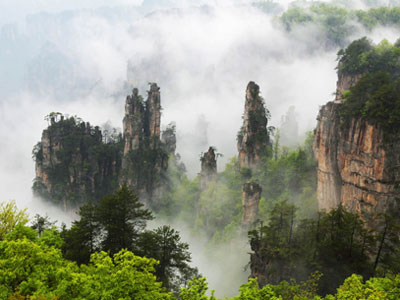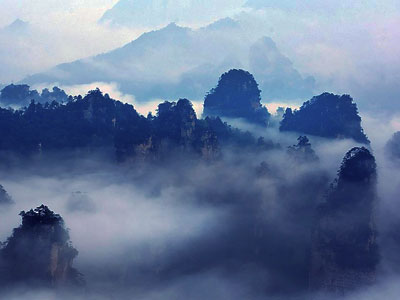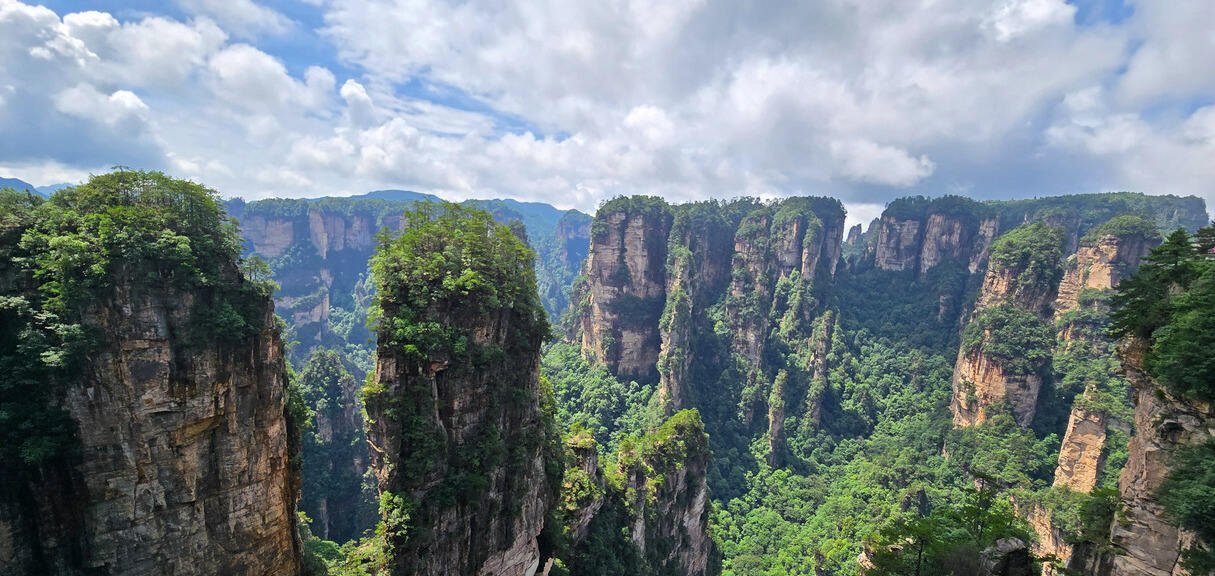
Often described by international visitors as “China’s Yellowstone Park”, Zhangjiajie is one of China’s most extraordinary natural destinations. Located in Hunan Province, this spectacular region is famous for its towering quartz sandstone pillars, deep ravines, mysterious caves, ancient forests, and unique ecosystems.
Covering an area of more than 264 square kilometers, the Wulingyuan Scenic and Historic Interest Area consists of three main sections: Zhangjiajie National Forest Park, the Suoxi Valley Scenic Area, and Tianzi Mountain.
The landscape is dominated by more than 3,103 unique sandstone peaks, many of which rise over 400 meters above the ground. Between these magnificent peaks are peaceful valleys, clear streams, waterfalls, natural bridges, and around 40 caves. Due to its remote location and excellent natural preservation, about 85% of the area is covered by forest and nearly 99% is covered by vegetation.
The scenery of Wulingyuan is renowned for its five natural wonders:
* Spectacular peaks
* Strange and beautiful rocks
* Secluded valleys
* Peaceful waters
* Deep karst caves
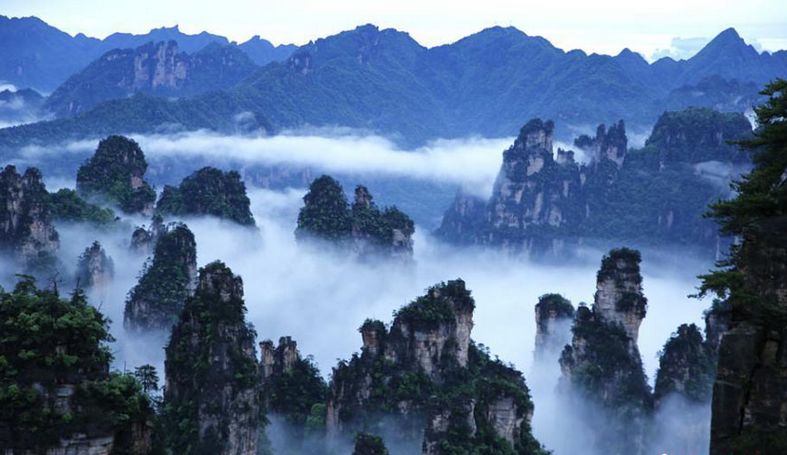 Together, these features create one of the most impressive mountain landscapes in the world.
Geological Features of Zhangjiajie
The geological history of Wulingyuan dates back hundreds of millions of years. The area was once covered by an ancient ocean. Through a series of geological movements, including the Wuling-Xuefeng Movement, Indo-China Movement, Yanshan Movement, Himalayan Movement, and later tectonic activities, the seabed gradually rose above the surface.
Over millions of years, natural forces such as weathering, erosion, and geological changes shaped the region into its present landscape of quartz sandstone pillars and dramatic cliffs.
The quartzite sandstone formations of Wulingyuan are internationally unique because of their enormous quantity and high purity, containing approximately 75%–95% quartz. Depending on the season, weather, and lighting conditions, these mountains display constantly changing views.
Among the most famous viewpoints is Tuerwangyue Peak (Rabbit Watching the Moon Peak), the highest peak in the area. Tianzi Mountain is also highly recommended for its panoramic views of endless sandstone peaks.
Natural Bridges and Amazing Caves
Wulingyuan is home to several impressive natural wonders, including two spectacular natural bridges:
Xianren Qiao (Bridge of the Immortals)
This natural stone bridge is about 26 meters long, 1.5–1.8 meters wide, and 1–2 meters thick. It stands approximately 100 meters above the valley, creating a breathtaking sight.
 Tianxia Diyi Qiao (The First Bridge Under Heaven)
One of the largest natural bridges in the area, it is about 40 meters long, 10 meters wide, and 15 meters thick. Suspended around 357 meters above the valley floor, it is considered one of the highest natural bridges in the world.
Besides sandstone peaks, Wulingyuan also contains many karst landscapes. Around one-third of the area consists of limestone formations, with approximately 40 caves mainly distributed along the Suoxi River and the southeastern side of Tianzi Mountain.
Among them, Huanglong Cave (Yellow Dragon Cave) is one of the largest caves in China. Stretching about 11 kilometers, it features four layers, an underground lake, two rivers, four pools, thirteen halls, 96 corridors, and three waterfalls, including one measuring 50 meters high.
The caves are famous for their impressive calcite formations, stalactites, and stalagmites. Many streams also disappear underground and flow for long distances before emerging again. Local legends and poetic names add even more mystery and charm to these natural wonders.
Rich Flora and Wildlife of Zhangjiajie
Wulingyuan is often called a green treasure house and natural zoo because of its incredible biodiversity. Located in the Central China Botanical Region of the Sino-Japanese Botanical Zone, the area served as a refuge for many ancient species during the Quaternary Glacial Period.
The region contains:
* More than 3,000 plant species
* Over 700 types of trees
* Around 450 varieties of ornamental flowers
* Approximately 116 species of vertebrates
More than 97.7% of Zhangjiajie National Forest Park is covered by primitive subtropical forest. Among the 191 recorded tree species are rare plants such as ginkgo and spruce.
The forest is also home to many beautiful flowers, including lobster flowers, giant mountain lotus, azaleas, plum blossoms, and orchids. Flowers bloom throughout the year, filling the mountains with fragrance.
 The wildlife of Wulingyuan is equally impressive. Visitors may encounter rare animals including:
* Chinese giant salamander
* Asiatic black bear
* Clouded leopard
* Chinese water deer
* Rhesus monkeys
* Civets
* Pangolins
The area also protects many rare bird species, including tragopan, golden pheasant, white-headed duck, and red-billed leiothrix.
Historical and Cultural Heritage of Wulingyuan
Although today Zhangjiajie is internationally famous, the Wulingyuan region was once considered a remote and mysterious land. According to local legends, Zhang Liang, a famous strategist of the Han Dynasty (206 BC–220 AD), lived here in seclusion and was later buried beneath Qingyan Mountain, now known as Zhangjiajie Mountain.
The beauty of this region was also mentioned in writings by Liu Zongyuan, a renowned writer of the Tang Dynasty (618–907 AD).
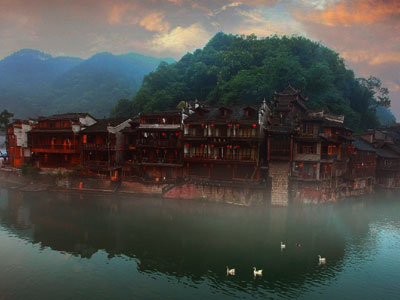
The area has long been home to ethnic minority communities, especially the Tujia, Miao, and Bai peoples, who continue to preserve their traditional customs, festivals, and lifestyles.
Nearby Zhangjiajie City, historically known as Dayong, contains many cultural relics and historic sites, including:
* Puguang Temple – a historic temple combining Chinese Buddhism, Taoism, and architectural styles from the Song, Yuan, Ming, and Qing Dynasties.
* Yuhuang Cave – a 200-year-old grotto featuring 19 stone-carved figures and more than 50 additional carvings.
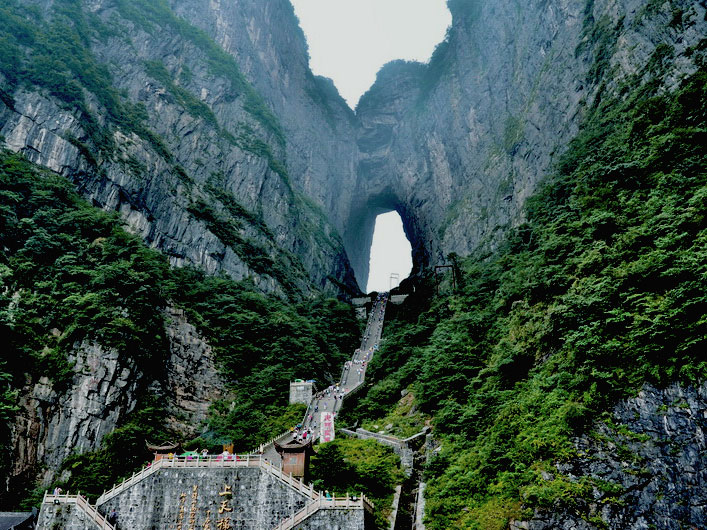
* Tianmen Mountain – known as the “Gateway to Heaven” because of its dramatic natural arch.
* Maoyan River – a 50-kilometer-long river flowing through spectacular mountain scenery.
Travel Experience in Zhangjiajie
With its towering peaks, mysterious caves, ancient forests, and rich ethnic culture, Zhangjiajie Wulingyuan Scenic Area offers a once-in-a-lifetime travel experience. Its unique landscape has inspired artists, photographers, and filmmakers around the world, earning it the nickname “Avatar Mountains of China.”
For nature lovers, adventure seekers, and travelers looking for China’s most unforgettable scenery, Zhangjiajie is one of the country’s must-visit destinations.
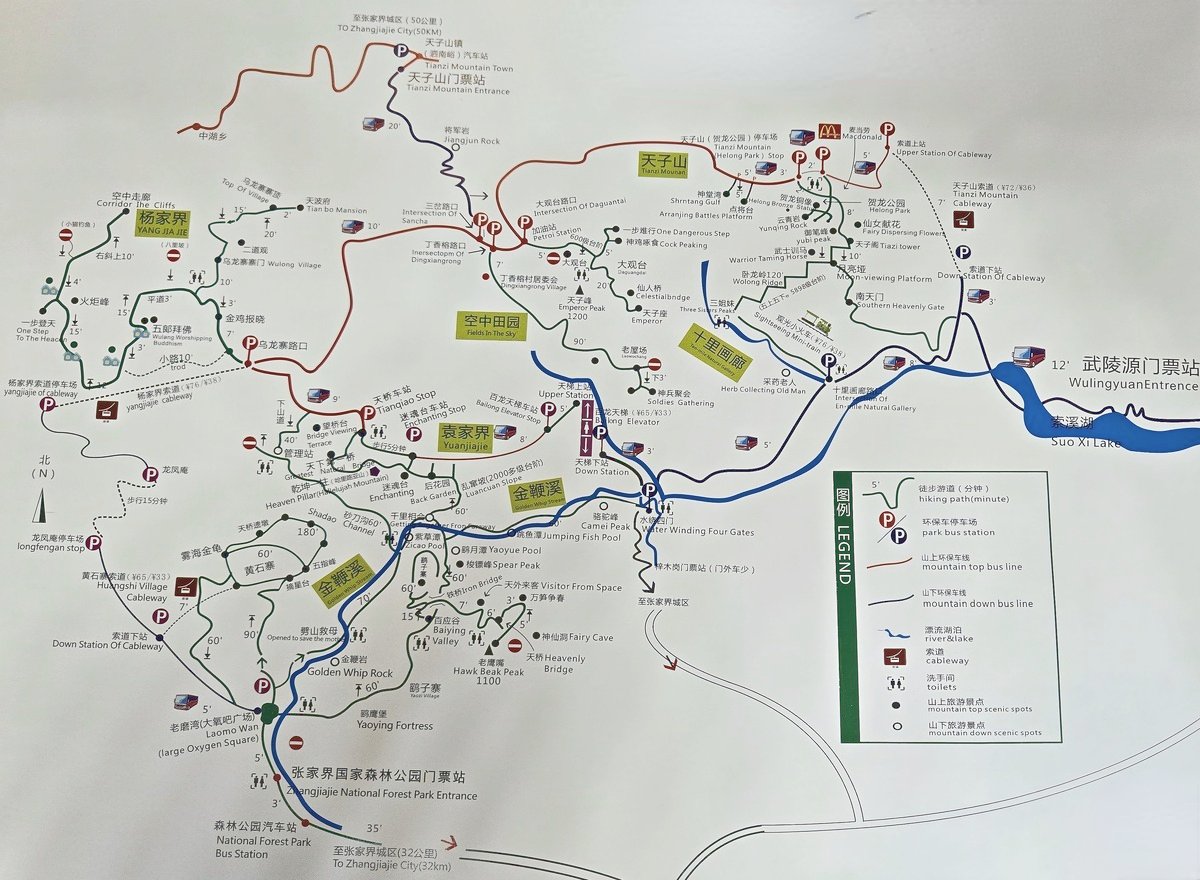
Tour Map of Wulingyuan National Park of Zhangjiajie
Weather Information of Zhangjiajie
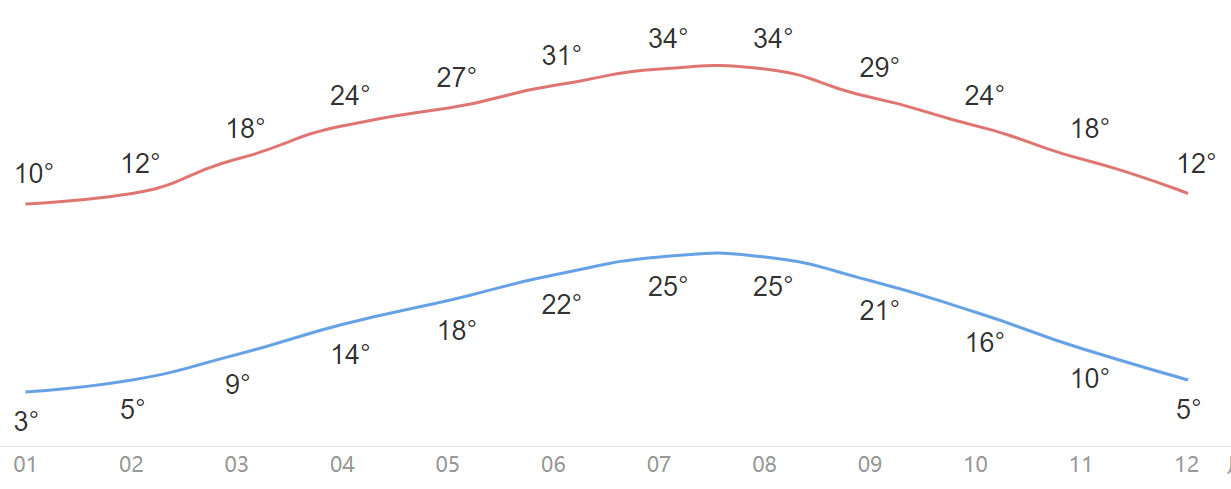
Note: From January to December, red line is the highest Centigrade in average, blue line is the lowest climate in average.
Related Tours
Three Days Hallelujah Hill Tour
China Daoism Sacred Mountain Pilgrim
The Geologic Investigation and Expedition in Western China
Fixed Overland tour from Kyrghyzstan to Laos in 2015
2015 China Overland Tour of Self driving From Laos To Mongolia by Own Vehicle
18 Days Ancient China Culture Tours
28 Days All China Around Exploration