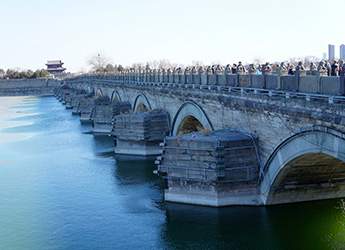
 Located in southwestern Beijing, the Marco Polo Bridge (Lugou Bridge) is one of the oldest and most famous bridges in the city. With a history of more than 800 years, the bridge is renowned for its traditional Chinese architecture, hundreds of stone lions, and its important role in modern Chinese history.
The bridge became internationally famous because the July 7 Incident in 1937, when Japanese forces attacked the bridge, marked the beginning of the full-scale War of Resistance Against Japan.
Today, Marco Polo Bridge is an important historical attraction in Beijing, combining ancient engineering, cultural heritage, and historical significance.
History of Marco Polo Bridge
The Marco Polo Bridge was originally constructed in 1189 during the Jin Dynasty (1115–1234) under the reign of Emperor Shizong.
Over the centuries, the bridge suffered damage from floods and was restored several times, including major renovations in:
* 1444 during the Ming Dynasty
* 1698 during the Qing Dynasty
The bridge stretches across the Yongding River and features 11 stone arches. Although the river channel beneath the bridge has changed significantly over time, the bridge remains one of the best-preserved examples of ancient bridge architecture in Beijing.
Originally, the Yongding River was called the Wuding River, meaning the “River of Instability,” because of its unpredictable water flow. During the Qing Dynasty, Emperor Kangxi renamed it the Yongding River, meaning “Eternally Stable River,” hoping to symbolize peace and stability.
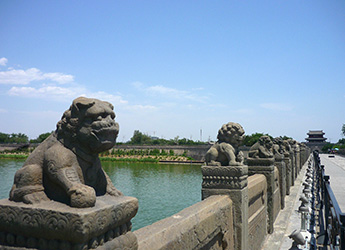 The Famous Stone Lions of Lugou Bridge
One of the most remarkable features of Marco Polo Bridge is its collection of stone lions.
The bridge is decorated with 485 stone lions placed on 140 balusters, each carved in different poses and expressions. Some lions are large and powerful, while others feature smaller lions hidden beneath them.
A traditional saying among local residents claims:
“The lions on Lugou Bridge are impossible to count.”
These artistic sculptures represent the excellent craftsmanship of ancient Chinese stone carving and have become a symbol of the bridge.
Two important stone steles also stand beside the bridge:
* One records the restoration of the bridge under Emperor Kangxi in 1698
* The other displays the famous phrase “Moon over Lugou Bridge at Dawn”, written by Emperor Qianlong
The Marco Polo Connection
The bridge became known as Marco Polo Bridge in the West because it was described by the famous Italian traveler Marco Polo (1254–1324) in his travel account, The Travels of Marco Polo.
In his writings, Marco Polo praised the bridge’s impressive design and beauty, introducing it to European readers during the Middle Ages.
At that time, stories about China’s wealth, technology, and civilization fascinated Europeans. However, some readers found the descriptions so extraordinary that Marco Polo’s book was sometimes jokingly called Il Milione (“The Million Lies”).
The Name “Lugou Bridge”
The original name of the bridge was Guangli Bridge, but local people traditionally called it Lugou Qiao, meaning “Reed Ditch Bridge.”
The name comes from the old Beijing dialect:
* Lu means reed
* It could also refer to the dark color of the river in historical usage
The Yongding River was once called the Heishui River (Black Water River).
In ancient Beijing, Lugou Bridge was considered one of the Eight Scenic Views of Yanjing (old Beijing). Visitors often came before sunrise to enjoy the beautiful scene of the moon reflected on the river, known as:
“Moon over Lugou Bridge at Dawn.”
Marco Polo Bridge and the July 7 Incident
The Marco Polo Bridge holds a special place in modern Chinese history.
On July 7, 1937, a military confrontation between Chinese and Japanese forces took place near the bridge. Known as the July 7 Incident (Lugou Bridge Incident), it became the starting point of Japan’s large-scale invasion of China.
Near the bridge is Wanping Town, where visitors can find the Museum of the War of Chinese People’s Resistance Against Japanese Aggression, which introduces the historical events surrounding the conflict.
Visiting Marco Polo Bridge Today
Today, Marco Polo Bridge offers visitors a chance to experience both ancient Chinese architecture and important historical memories.
Visitors can enjoy:
* Ancient stone bridge architecture
* Hundreds of unique stone lions
* Traditional Chinese carving art
* Historical monuments and inscriptions
* Nearby museums and cultural sites
The bridge is an ideal destination for travelers interested in:
* Beijing history
* Ancient Chinese architecture
* Chinese cultural heritage
* Modern historical events
Why Visit Marco Polo Bridge?
As Beijing’s oldest surviving bridge, Marco Polo Bridge represents more than a transportation structure. It reflects centuries of Chinese engineering, artistic achievement, and historical change.
From the elegant stone lions admired by Marco Polo to its important role in 20th-century history, Lugou Bridge provides a fascinating journey through China’s past.
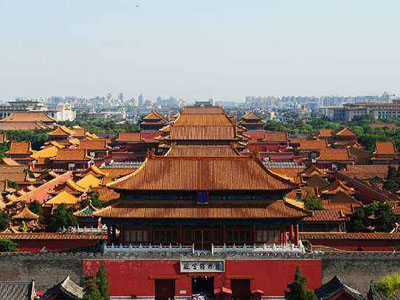
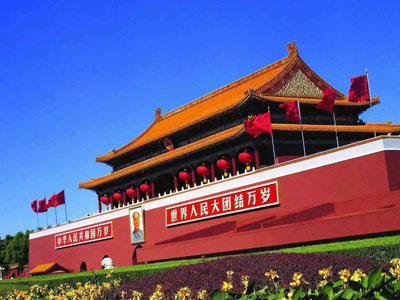
For visitors exploring Beijing beyond famous landmarks such as the Forbidden City and the Great Wall, Marco Polo Bridge is a meaningful cultural attraction that reveals another important chapter of the city’s history.