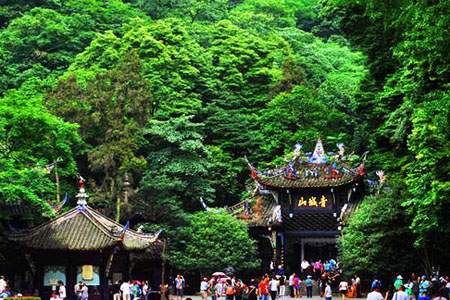
Located in Sanfeng Village, Heming Town, Dayi County, Sichuan Province, Mount Heming (also known as Singing Crane Mountain or Huming Mountain) is widely regarded as the birthplace of Taoism in China. Situated near Chengdu, this peaceful mountain combines beautiful natural scenery with more than 1,800 years of Taoist cultural heritage.
The mountain was named “Heming” because its shape resembles a flying crane, and according to legend, red-crowned cranes once lived among the peaks. Local stories tell of mysterious crane calls echoing from deep within the mountains, inspiring generations of visitors to explore its spiritual atmosphere.
Today, Mount Heming is an important Taoist cultural site and a popular destination for travelers seeking history, nature, and traditional Chinese philosophy.
The Birthplace of Taoism
According to historical records, during the reign of Emperor Shun of the Eastern Han Dynasty (126–144 AD), Zhang Daoling, the founder of Chinese Taoism, studied Taoist teachings at Mount Heming.
Legend says that the Supreme Master descended to the human world and taught Zhang Daoling the principles of Taoism, granting him the title of Celestial Master. Zhang Daoling later created the 24-chapter Taoist scriptures, established the Five Pecks of Rice Daoism (Tianshi Dao), and spread Taoist teachings throughout Sichuan.
Because of this important historical connection, Mount Heming is considered one of the most significant Taoist holy sites in China and is often called the “Cradle of Taoism.”
 Natural Scenery of Mount Heming
Surrounded by rivers on the east, west, and north sides and facing the fertile Chengdu Plain to the south, Mount Heming enjoys a beautiful natural environment.
The mountain is covered with lush pine and cypress forests, creating a peaceful landscape of green hills, clear streams, and fresh mountain air. With its mild climate and quiet surroundings, Mount Heming is also a popular summer retreat near Chengdu.
Visitors can enjoy:
* Ancient Taoist temples
* Forest hiking trails
* Mountain springs and streams
* Peaceful viewpoints overlooking the Chengdu Plain
* Traditional Taoist cultural experiences
Main Attractions of Mount Heming
Jieyuan Pavilion
Located at the eastern entrance of Mount Heming, Jieyuan Pavilion is one of the important landmarks of the mountain.
Beneath the pavilion stands the Three Officials Temple, dedicated to the Three Taoist Officials:
* Heavenly Official – believed to bring blessings and good fortune
* Earthly Official – believed to forgive sins and remove guilt
* Water Official – believed to relieve disasters and difficulties
The temple reflects traditional Taoist beliefs about harmony between heaven, earth, and humanity.
Singing Crane Stone
The Singing Crane Stone is connected with one of Mount Heming’s most famous legends.
According to local folklore, visitors who rub the stone may see the image of a crane appear. However, only people with sincere hearts are believed to have the chance to witness this mysterious phenomenon.
This legend has attracted countless visitors who come to experience the mountain’s unique Taoist atmosphere.
Legendary Taoist Tea
Mount Heming is also associated with a fascinating tea legend.
It is said that when tea made from a special local tea plant is brewed, the rising steam forms the shape of a crane. The tea is believed to have excellent color, aroma, and taste.
These stories have become an important part of Mount Heming’s cultural heritage and continue to attract visitors interested in traditional Chinese culture.
Hiking and Cultural Experience
Mount Heming offers a relaxing hiking experience combining natural beauty with Taoist traditions. Visitors can walk through forest paths, visit ancient temples, learn about Taoist philosophy, and enjoy the peaceful mountain environment.
The mountain’s fresh air, cool streams, gentle breezes, and beautiful scenery make it an ideal summer escape from Chengdu.
For travelers interested in Chinese philosophy, religion, and traditional culture, Mount Heming provides a unique opportunity to experience the origins of Taoism in an authentic setting.
Travel Information
Location: Dayi County, Chengdu, Sichuan Province
Distance from Chengdu: About 60 km
Best Time to Visit: Spring, summer, and autumn
Recommended Duration: Half day to one day
Suitable For: Culture lovers, hikers, families, and visitors interested in Taoism