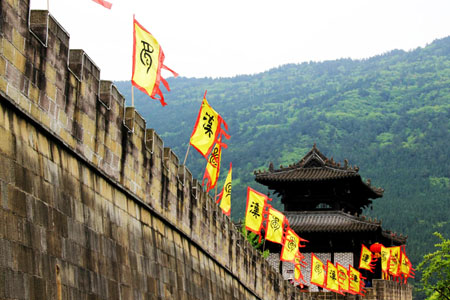
Feng Shui (风水) is a traditional Chinese system of thought concerned with the relationship between people, buildings, and their surrounding environment. The Chinese word feng means “wind,” while shui means “water.” In traditional Chinese culture, gentle winds and flowing water were associated with favorable natural conditions, health, and agricultural prosperity, while destructive winds and stagnant water were often associated with hardship and disease. Over time, feng shui came to symbolize the search for favorable environmental conditions and harmonious living.
Feng Shui is traditionally based on the idea that human beings are closely connected with the natural environment. Its practitioners study factors such as the orientation of buildings, terrain, landscape, watercourses, and the arrangement of interior and exterior spaces. The goal is traditionally described as achieving harmony between people and their surroundings and encouraging the favorable circulation of qi, or vital energy.
The Philosophy of Feng Shui
Feng Shui developed within the broader intellectual traditions of ancient China and incorporates concepts including yin and yang, the Five Elements, cosmology, astronomy, geography, and traditional ideas about the natural environment.
The relationship between Heaven, Earth, and humanity is particularly important. Heaven represents the broader patterns of the cosmos; Earth represents the physical environment in which people live; and humanity occupies a position between the two. Traditional Feng Shui seeks to understand the interaction of these forces and apply this knowledge to the selection and arrangement of living spaces.
Historically, Feng Shui was used in decisions concerning the orientation and location of houses, villages, tombs, palaces, and other structures. Practitioners traditionally considered factors such as mountains, rivers, prevailing winds, sunlight, terrain, and the relationship between a site and its surrounding landscape.
Feng Shui can therefore be understood not simply as a collection of decorative rules, but as part of a broader traditional Chinese approach to creating harmony between architecture, landscape, and human life.
History of Feng Shui
The ideas that eventually became associated with Feng Shui developed gradually over many centuries. Their roots can be found in ancient Chinese concepts concerning cosmology, geography, divination, astronomy, and the relationship between human beings and nature.
The theory of yin and yang, which became particularly influential during the late Zhou period, provided an important philosophical foundation. Yin and yang represent complementary and interdependent forces rather than absolute opposites. Their continuous interaction and transformation became central to traditional Chinese explanations of natural phenomena.
Early forms of Feng Shui were closely associated with the selection of favorable sites for settlements and tombs. Over time, these practices became increasingly systematized. During the imperial period, specialists who studied geography, astronomy, calendrical systems, and divination could serve at courts and advise rulers on important sites and construction projects.
Knowledge of these traditions was transmitted through written texts as well as through teacher-student relationships. Some schools placed particular emphasis on oral instruction and specialized methods passed down through generations.
Feng Shui and Chinese Architecture
Feng Shui had an important influence on traditional Chinese architecture and landscape design. The location and orientation of a building could be considered in relation to surrounding mountains, rivers, roads, vegetation, sunlight, and prevailing winds.
Traditional Chinese cities and buildings often demonstrate an awareness of environmental factors that can also be understood through Feng Shui principles. The ideal site was generally one that provided protection, access to water, favorable sunlight, and a harmonious relationship with the surrounding landscape.
These principles can be observed in different forms of traditional architecture, from imperial complexes and temples to villages, private residences, and classical gardens.
Yin and Yang
Yin and yang form one of the fundamental concepts underlying traditional Chinese cosmology and Feng Shui. The familiar symbol represents two complementary forces that exist in a dynamic relationship.
Yang is traditionally associated with qualities such as light, warmth, activity, and upward movement, while yin is associated with darkness, coolness, stillness, and inward or downward movement. Neither is considered completely independent of the other. Instead, yin and yang constantly interact, transform, and depend upon one another.
In Feng Shui, the ideal environment is traditionally understood as one in which yin and yang are appropriately balanced rather than dominated by either extreme. This principle of balance and harmony also appears throughout Chinese philosophy, medicine, architecture, landscape design, and traditional arts.
Feng Shui Today
Feng Shui remains an important element of traditional Chinese culture and is practiced in many Chinese communities, including those in mainland China, Hong Kong, Taiwan, Singapore, Malaysia, and overseas Chinese communities.
In recent decades, Feng Shui has also attracted considerable interest in Europe, North America, Australia, and other parts of the world. Modern interpretations range from the study of traditional Chinese philosophy and architecture to popular approaches involving interior decoration and lifestyle.
It is important, however, to distinguish traditional Feng Shui from modern commercial “Feng Shui remedies.” Objects such as crystals, lucky ornaments, and particular colors are often marketed as Feng Shui cures, but their importance varies considerably among different schools and is not necessarily representative of classical Feng Shui.
From a historical and cultural perspective, Feng Shui is best understood as a traditional Chinese system for interpreting the relationship between human beings and their environment. Whether approached as cultural heritage, architectural philosophy, or a traditional practice, it provides an interesting perspective on the longstanding Chinese ideal of living in harmony with nature.
Related Tours
Buddhism Pilgrimage Tour
China Festival Tours
China Daoism Sacred Mountain Pilgrim
Tibet Tours
China Hiking & Trekking Tour
Mt. Emeishan Hiking Exploration