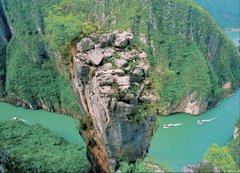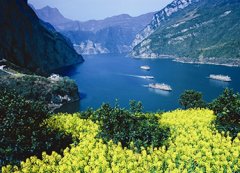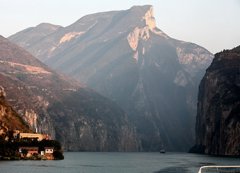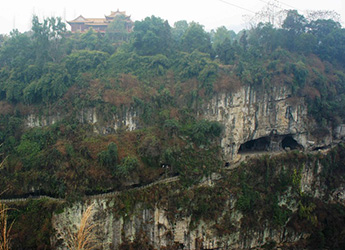
Leaving the magnificent Xiling Gorge of the Three Gorges and traveling east along the Yangtze River, visitors will discover Sanyoudong Cave (Three Travelers’ Cave 三游洞) on the northern bank of the river. Located about 10 kilometers from downtown Yichang, this historic cave combines spectacular natural scenery with a rich literary heritage, making it one of the most famous cultural attractions in the Three Gorges region.
Surrounded by mountains, rivers, and picturesque landscapes, Sanyou Cave looks like a natural painting created by nature. Nestled in a deep valley, the cave enjoys a pleasant climate—warm in winter and cool in summer—offering visitors a comfortable environment throughout the year.
The cave extends approximately 30 meters in depth, 23 meters in width, and 9 meters in height. Inside, numerous stalagmites and stalactites create a fascinating underground landscape. Three major stalagmites divide the cave into two chambers, giving rise to its unique structure.
The front chamber is spacious and well-lit, with more than 40 stone tablets preserved along the walls. These inscriptions feature poems and essays written by famous scholars who visited the area throughout Chinese history. Among the most notable inscriptions are works by Ouyang Xiu, one of the greatest writers of the Song Dynasty (960–1279), and Bai Juyi, one of the most celebrated poets of the Tang Dynasty (618–907).
The rear chamber is darker and deeper, featuring unusual stalactite formations and mysterious natural sounds. According to local legend, when a stone is thrown at some stalactites, the echo resembles the sound of a bell, while stones falling into the water create an echo similar to a drum. This unique acoustic phenomenon has added to the cave’s charm and popularity among visitors.
Near Sanyoudong Cave lies Yu Spring (Jade Spring), another scenic attraction known for its crystal-clear water and elegant surroundings. Historically, Yu Spring was regarded as one of the “Four Finest Scenic Spots of China,” together with Qixia Temple, Lingyan Temple, and Mount Tiantai. These four destinations were frequently mentioned in ancient Chinese poems and writings.
For travelers exploring Yichang, Sanyou Cave and Gezhouba Dam are two attractions that should not be missed. Together, they offer a wonderful combination of natural beauty, engineering achievement, and Chinese cultural history.
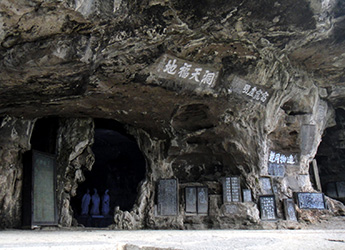 History of Sanyoudong Cave
Located on the northern bank of the Yangtze River, Yichang has long been an important strategic location. During the Three Kingdoms period (221–263), the region served as a major battlefield due to its key geographic position.
Sanyoudong Cave gained its fame through visits and writings by many renowned poets and literary figures. During the Tang Dynasty, three famous scholars—Bai Juyi, Yuan Zhen, and Bai Xingjian—visited the cave while serving as local officials. Their visit was later recorded as the “Initial Three Travelers.”
Centuries later, during the Song Dynasty, the three famous writers Su Xun, Su Shi, and Su Zhe also explored the cave. Their visit became known as the “Subsequent Three Travelers.”
Because of these visits by some of China’s greatest literary figures, Sanyou Cave became more than a natural wonder. It developed into a treasured cultural landmark where stunning landscapes and centuries of Chinese literature come together.