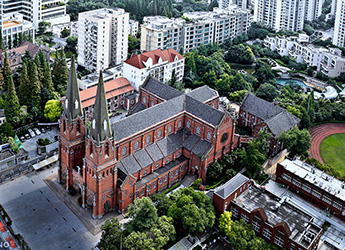
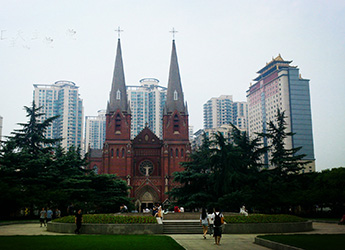
Located in the Xujiahui area of Shanghai, St. Ignatius Cathedral (also known as Xujiahui Catholic Church, 徐家汇天主教堂) is one of the most famous Catholic churches in China and the largest Catholic cathedral in Shanghai. Its official name is the St. Ignatius Cathedral of Shanghai.
Built in the late Qing Dynasty in 1904, the cathedral features a magnificent French Gothic architectural style. With its towering twin bell towers, red brick walls, white stone columns, and elegant interior decorations, it has become one of Shanghai’s most impressive examples of Western religious architecture. The cathedral is also listed as a protected cultural heritage site of Shanghai.
The church can accommodate around 3,000 worshippers for religious activities, while more than 4,000 people can gather inside during major celebrations. Today, it remains the center of Catholic activities in Shanghai, with tens of thousands of local believers attending regular Mass and important religious festivals.
Gothic Architecture and Design
Xujiahui St. Ignatius Cathedral was designed in the style of medieval French Gothic architecture. The building has a cross-shaped layout, facing east and extending approximately 83.3 meters in length. The widest section of the church reaches 34 meters, while the main hall ridge stands about 26 meters high.
The two magnificent bell towers on the front façade dominate the skyline. Originally reaching around 60 meters high, the towers feature elegant spires and create a solemn and majestic appearance. The combination of red brick walls, white stone decorations, gray slate roofs, and colorful stained-glass windows gives the cathedral a unique European atmosphere.
When it was completed, the cathedral was regarded as one of the finest buildings in Shanghai and was once the tallest structure in the city before the 1920s.
Inside the church, the statue of the Madonna holding the infant Jesus is another important highlight. Created in Paris in 1919, the statue was later transported to Shanghai and has become a treasured religious artwork.
 History of Xujiahui Cathedral
The history of Xujiahui Catholic Church is closely connected with the development of Catholicism in Shanghai.
Catholic missionary activities began in Shanghai during the early 17th century. In 1640, the first official Catholic church was built in the city, although it followed traditional Chinese temple-style architecture. Later, during the Qing Dynasty, missionary activities were restricted, and the building was converted into a temple.
The Xujiahui area was originally a quiet village. It became associated with Xu Guangqi, a famous Chinese scientist, statesman, and Catholic believer of the Ming Dynasty, whose tomb was located nearby.
After the First Opium War, Jesuit missionaries returned to Shanghai and established their religious center in Xujiahui. In the following years, churches, monasteries, libraries, museums, observatories, and schools were built in the area, making Xujiahui an important Catholic missionary center south of the Yangtze River.
In 1896, the Jesuits decided to construct a new cathedral. The new church was completed and officially opened in 1904. Since the patron saint of the parish was St. Ignatius, the cathedral was named St. Ignatius Cathedral.
In 1924, the First National Bishop Conference of Catholicism in China was held at the cathedral. During the early period of the Anti-Japanese War, nearby schools and facilities were used as shelters, helping tens of thousands of refugees.
Restoration and Present Day
During the Cultural Revolution, the cathedral suffered serious damage. The tops of the bell towers were removed, and many stained-glass windows were destroyed. The building was later used as a warehouse by the Shanghai Fruit and Grocery Company.
Restoration work began after 1978, returning the cathedral to its original religious function and architectural beauty.
Today, Xujiahui St. Ignatius Cathedral remains an important Catholic center in Shanghai. Regular Mass services are held every morning, and large numbers of worshippers gather every Sunday and during major Catholic festivals.
For visitors interested in architecture, history, and cultural exchanges between China and the West, Xujiahui St. Ignatius Cathedral is one of Shanghai’s most remarkable historical landmarks.