 Fanjing Mountain (Mount Fanjing), whose name means “Pure Land of Brahma,” is located at the junction of Yinjiang, Jiangkou, and Songtao counties in Tongren City, Guizhou Province, China. As the highest peak of the Wuling Mountain Range, it rises to 2,572 meters (8,438 ft) above sea level.
Recognized as one of China’s most remarkable natural treasures, Fanjing Mountain preserves geological formations dating back 1.4 billion years, making it one of the earliest landmasses to emerge from the ancient sea in southern China. It is famous for its spectacular rock formations, pristine forests, rich biodiversity, and sacred Buddhist heritage.
In 2018, Fanjing Mountain was inscribed as China’s 13th UNESCO World Natural Heritage Site. It is also a National Nature Reserve of China and one of the country’s most important ecological conservation areas.
A Biodiversity Hotspot
Often called the “Gene Pool of Biodiversity” and the “Green Oasis of the Earth,” Fanjing Mountain is one of the richest biodiversity regions at the same latitude on Earth.
The mountain boasts an impressive 97.6% forest coverage and is home to:
* More than 2,000 species of plants
* 31 nationally protected plant species
* Over 800 species of wild animals
* 19 nationally protected animal species
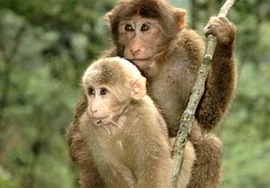
Fanjing Mountain is the only natural habitat of the endangered Guizhou Snub-nosed Monkey (Guizhou Golden Monkey). Other rare wildlife found here includes the clouded leopard, macaque, Assamese macaque, forest musk deer, Chinese pangolin, mandarin duck, white-necklaced pheasant, giant salamander, and many other protected species.
Thanks to its exceptional ecological value, Fanjing Mountain is widely regarded as one of China’s most important nature reserves and a paradise for wildlife enthusiasts, photographers, and eco-travelers.
The Sacred Buddhist Mountain of Maitreya
Besides its natural beauty, Fanjing Mountain is one of the most important Buddhist sacred mountains in China and is traditionally regarded as the Bodhimanda (Sacred Place) of Maitreya Buddha, the Buddha of the Future.
For centuries, Buddhist pilgrims have climbed the mountain to worship at its ancient temples, creating a unique blend of spectacular natural scenery and profound religious culture.
Main Attractions of Fanjing Mountain
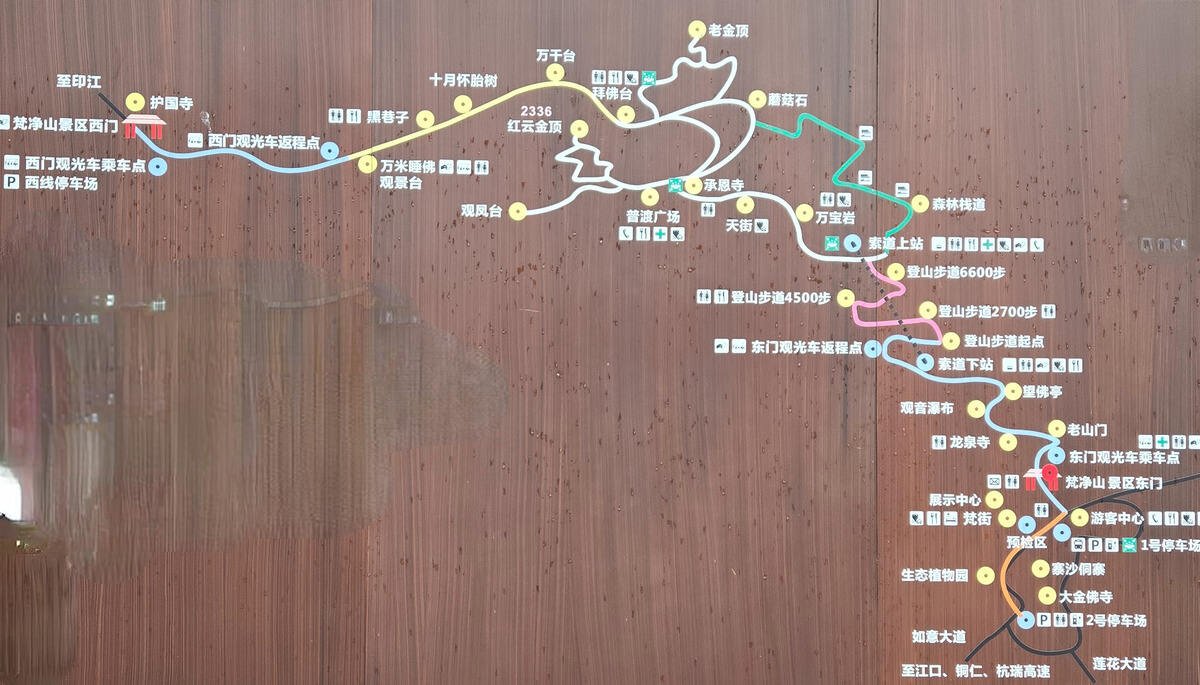
 Mushroom Rock
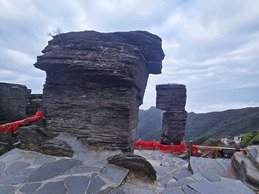
Mushroom Rock is the iconic landmark of Fanjing Mountain. Standing about 10 meters high, this extraordinary rock formation resembles a giant mushroom with a narrow base supporting a massive upper section.
Balanced naturally for over one billion years, Mushroom Rock symbolizes the Buddhist philosophy of maintaining an ordinary and peaceful mind. Today, it has become the most recognizable image of Fanjing Mountain and a favorite subject for photographers and artists worldwide.
Old Golden Summit (Laojinding)
The Old Golden Summit (Laojinding) stands at 2,493 meters above sea level and is the mountain’s second-highest peak.
Also known as Moon Mirror Mountain, it is famous for the mysterious moonlit reflections that resemble images of Maitreya Buddha. At the summit stands the Dipankara Buddha Hall, dedicated to Dipankara Buddha, one of the Buddhas of the past in Buddhist tradition.
Wanjuan Book Peak
Wanjuan Book Peak, meaning “Peak of Ten Thousand Books,” is closely associated with Buddhist legend.
According to folklore, the famous monk Xuanzang visited Fanjing Mountain after returning from India. During his journey, bundles of Buddhist scriptures were accidentally scattered across the mountain, eventually transforming into the layered rock formations seen today, giving rise to the name “Peak of Ten Thousand Books.”
Pudu Square
Pudu Square is one of the main resting and viewing areas for visitors climbing the mountain. Situated at a high elevation, it offers magnificent panoramic views of the surrounding peaks and serves as an important stop for Buddhist pilgrims on their journey toward the summits.
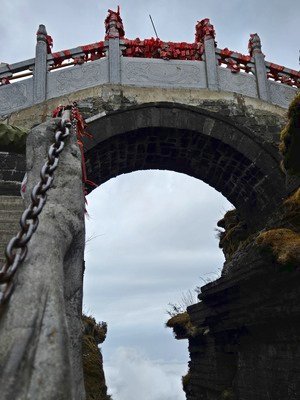 Red Clouds Golden Summit (Hongyun Jinding)
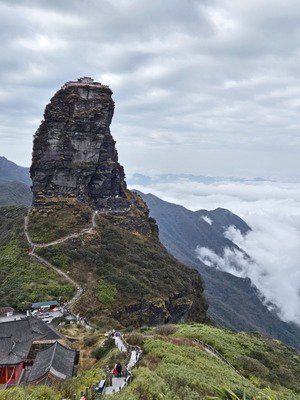
The Red Clouds Golden Summit (Hongyun Jinding) is the most famous attraction in Fanjing Mountain and one of China’s most spectacular mountain peaks.
Standing at 2,336 meters above sea level with a vertical cliff of nearly 100 meters, the summit is split into two sections by a narrow natural fissure known as the Golden Knife Gorge.
The southern summit houses Sakyamuni Buddha Hall, while the northern summit enshrines Maitreya Buddha Hall. A narrow stone bridge connects the two temples, creating one of the most breathtaking architectural landscapes in China.
When viewed from different angles, the summit resembles clasped hands in Buddhist meditation or a symbol of life, earning it the title “The First Peak Under Heaven.” At sunrise, the mountain is often surrounded by glowing red clouds, giving the peak its name and creating one of the most unforgettable sights in China.
Climate
Fanjing Mountain experiences a subtropical monsoon climate, influenced by the Southeast Asian and Pacific monsoon systems. The mountain enjoys mild temperatures, abundant rainfall, and comfortable weather throughout most of the year.
* Average annual temperature: 13.1°C–14.7°C (55.6°F–58.5°F)
* Average July temperature: 25.3°C (77.5°F)
* Average February temperature: 2°C (35.6°F)
Because of its high elevation, temperatures decrease noticeably with altitude, making Fanjing Mountain an ideal summer retreat with cool mountain air and lush green forests.