 Located in the southwest of Guangzhou City, Guangdong Province, Shamian Island (also known as Sand Island) is one of the city’s most famous historical and cultural landmarks.
The name “Shamian” means “sand surface” in Chinese. The island was formed from sand deposits carried by the Pearl River, creating a natural sandbank that eventually developed into today’s historic district.
Covering an area of approximately 0.3 square kilometers, Shamian Island is a small but culturally significant area with eight main streets and lanes. It is surrounded by the Pearl River to the south and faces 623 Road to the north.
With its peaceful tree-lined streets, European-style buildings, and rich historical background, Shamian Island is often described as an open-air architectural museum in Guangzhou.
History of Shamian Island – A Witness to Guangzhou’s Modern Development
From the Song, Yuan, Ming, and Qing dynasties, Shamian served as an important port for domestic and international trade in Guangzhou.
During the 19th and early 20th centuries, Shamian became a major foreign commercial area. More than ten countries established consulates on the island, while numerous foreign banks and trading companies operated here.
During this period, Shamian became home to:
* Foreign consulates
* International banks
* Trading institutions
* The Guangdong Customs Club
* The Guangzhou Club
The island witnessed many important moments in Guangzhou’s modern history and preserved the footprints of influential figures such as Dr. Sun Yat-sen and Premier Zhou Enlai.
Today, Shamian Island represents an important chapter of China’s modern history and the former concession era, with its unique European-style architecture creating a rare historical landscape in southern China.
Main Attractions on Shamian Island
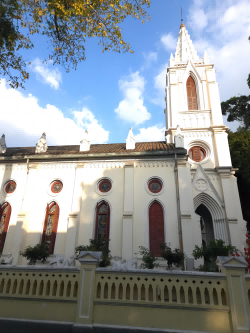
Our Lady of Lourdes Catholic Church
The Our Lady of Lourdes Catholic Church is one of the most beautiful religious buildings on Shamian Island.
Built during the French concession period, the church was established for the religious activities of the French community in Guangzhou.
The church is named after Our Lady of Lourdes, with a statue of the Virgin Mary placed inside the garden area south of the building.
Its elegant French architectural style makes it a popular destination for visitors interested in history, religion, and photography.
Guangdong Museum of Foreign Affairs
Located at No. 20 Shamian South Street, the Guangdong Museum of Foreign Affairs is the first local foreign affairs museum in China.
The museum is housed in a Baroque-style building constructed in 1890, which originally served as the French Consulate in Guangzhou. It is now recognized as an important historical building within the Shamian architectural complex and a National Key Cultural Relics Protection Unit.
Inside the museum, visitors can learn about:
* Guangdong’s diplomatic history
* Major foreign affairs events over the past century
* International exchanges between Guangdong and other countries
The museum also displays more than 200 precious gifts presented to Guangdong by 122 friendly provinces and states around the world.
A special exhibition area features more than 100 historical photographs of Shamian from a century ago, allowing visitors to explore the island’s transformation over time.
Shamian Christ Church
Located on Shamian Fifth Street, Shamian Christ Church was built in 1864 during the British concession period.
Originally established as an Episcopal church serving foreign residents, it was managed by pastors from Hong Kong and held English-language services.
As one of Guangzhou’s best-preserved historic Christian buildings, the church has become a popular location for wedding photography due to its beautiful architecture and romantic atmosphere.
Customs House (Red Building)
The Customs House, also known as the Red Building, is one of Shamian Island’s most recognizable landmarks.
Originally built as part of the French concession area, the building was used as a customs facility. Before the founding of the People’s Republic of China, it served as the Guangdong Customs Club.
Designed by Australian architect Pane, the building features:
* A south-facing layout
* Unique architectural design
* Distinctive red exterior decoration
Because of its bright red color, locals commonly call it the “Red Building.”
Its special location and striking appearance make it one of the most photographed buildings on Shamian Island.
Former HSBC Bank Building
The former HSBC Bank Building is located at the northeast corner of the intersection of Shamian Street and Shamian Fourth Street.
The building combines Western classical architectural elements with local design features, including:
* Gray and white granite decorations
* Classical-style entrance design
* Large arched windows
* Imitation stone wall details
Its elegant appearance reflects the international commercial atmosphere that once existed on Shamian Island.
Former Soviet Consulate (West Red Building)
Located at No. 68 Shamian Street, the former Soviet Consulate is another representative historic building on the island.
Built in the British Victorian style, the three-story brick and reinforced concrete structure features:
* A south-facing design
* Exterior corridors
* Decorative red brick details
* Balconies and traditional architectural elements
Because of its distinctive red brick appearance, it is known as the “West Red Building” of Shamian Island.
Together with the Customs House, it forms part of Shamian’s unique red architectural landscape.
Why Visit Shamian Island?
Shamian Island offers visitors a rare opportunity to experience the combination of Chinese history and European architecture in the heart of Guangzhou.
A visit to Shamian Island allows travelers to enjoy:
* Beautiful colonial-era architecture
* Historic consulates and churches
* Peaceful tree-lined streets
* Pearl River scenery
* A glimpse into Guangzhou’s international trading history
Unlike the busy modern districts of Guangzhou, Shamian provides a quiet and elegant atmosphere where visitors can walk through history.
For travelers interested in Guangzhou culture, architecture, photography, and modern Chinese history, Shamian Island is one of the city’s must-visit attractions.