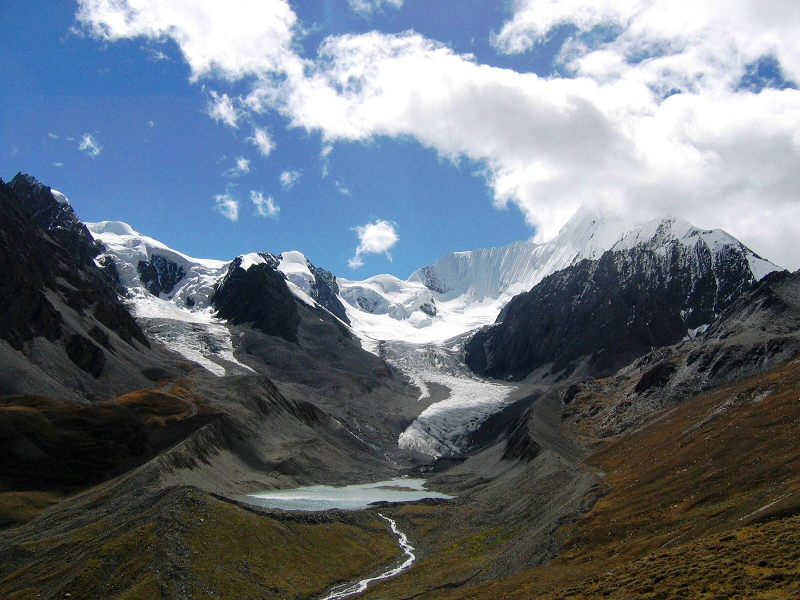
 Located south of Kangding in Sichuan Province, Gongga Mountain (Tibetan: Minya Konka) is the main peak of the Daxue Mountain Range. In Tibetan, “Gong” means ice and snow, while “Ga” means white, together representing the meaning of a “White Iceberg.” Rising 7,556 meters above sea level, Gongga Mountain is known as the “King of Sichuan Mountains” and is the highest peak in Sichuan Province.
Stretching approximately 60 kilometers from north to south and 30 kilometers from east to west, Gongga Mountain is surrounded by 45 peaks above 6,000 meters. The towering main peak stands above the surrounding snow mountains, creating one of the most spectacular high-altitude landscapes in China.
Centered around the main peak, Gongga Mountain Scenic Area covers an area of about 10,000 square kilometers and includes famous scenic areas such as Hailuogou Glacier, Mugecuo Lake, Wuxuhai Lake, and the Gongga South Slope. It is a national-level scenic area combining snow mountains, glaciers, forests, lakes, hot springs, and Tibetan culture.
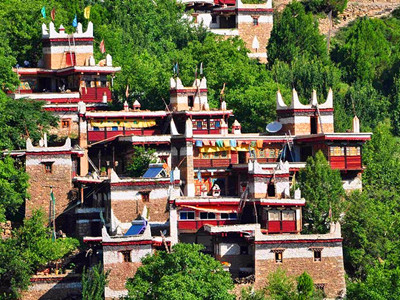
The Gongga Mountain region is inhabited mainly by Tibetan and Yi ethnic groups. Visitors can experience unique local traditions and explore Tibetan Buddhist monasteries, including Gongga Temple and Tagong Temple, while enjoying the magnificent scenery of the western Sichuan plateau.
Influenced by the Indian Ocean monsoon, the snow line of Gongga Mountain lies between 4,600 and 4,700 meters above sea level, allowing extensive glacier development. The famous Hailuogou Glacier, the largest glacier on the eastern slope of Gongga Mountain, extends for 14.2 kilometers, with its glacier tongue reaching down to an altitude of only 2,850 meters, entering the surrounding forest zone.
After thousands of years of glacial erosion, Gongga Mountain has formed a steep cone-shaped peak surrounded by cliffs with angles of 60–70 degrees, making it one of the most challenging mountains to climb in the world. An American expedition successfully reached the summit in 1932, while the Chinese mainland mountaineering team conquered the peak in June 1957.
With its snow-covered summit, dramatic glaciers, and a vertical elevation difference of about 6,500 meters from the eastern slope to the peak, Gongga Mountain represents a typical extreme high mountain landscape. It is not only the highest mountain in Sichuan but also the highest peak in the Hengduan Mountain Range on the southeastern Qinghai-Tibet Plateau.
A World-Famous Mountaineering Destination
Gongga Mountain is considered one of the most challenging peaks in the world. Its climbing difficulty is even greater than Mount Everest due to its steep terrain, unpredictable weather, glaciers, and complex routes.
According to historical records, only a limited number of climbers have successfully reached the summit, while many mountaineers have lost their lives during expeditions. The mountain’s extreme conditions have earned it a reputation as one of the most difficult high-altitude peaks to conquer.
Beyond mountaineering, Gongga Mountain is also an important destination for scientific research. The region contains 159 modern glaciers covering more than 390 square kilometers, making it one of the world’s important areas for studying maritime mountain glaciers.
With endless snow peaks, deep valleys, ancient glaciers, alpine forests, and Tibetan cultural heritage, Gongga Mountain is a paradise for mountaineers, hikers, photographers, and nature lovers.
Main Attractions of Gongga Mountain
Gongga Temple
Gongga Temple is one of the three most important spiritual centers of the Karma Kagyu tradition of Tibetan Buddhism, together with Chubu Monastery in Tibet and Babang Monastery in Dege.
The temple has produced many renowned Buddhist scholars, including the Ninth Gongga Living Buddha, Karma Xiezhu Quejie Shenggen, who was famous for his achievements in Tibetan studies.
Gongga Temple consists of the Old Gongga Temple and the New Gongga Temple. The Old Gongga Temple is located beneath the main peak of Gongga Mountain and has become an important stop for hikers crossing the Gongga Snow Mountain trekking route.
Built in the mid-13th century by Zhabaiba, a disciple of the Second Karmapa Karma Pakshi, the Old Gongga Temple has a history of more than 600 years. It has served as a sacred retreat for generations of Gongga Living Buddhas and remains an important pilgrimage site today.
Tianwan River
Originating from the southern slope of Gongga Mountain, Tianwan River flows through one of the most beautiful areas of the scenic region.
Along the river, more than ten snow-covered peaks above 5,000 meters create a magnificent alpine landscape. The famous “Rizhao Jinshan” (Golden Mountain under Sunshine) phenomenon, when sunlight illuminates the snow-covered peaks, is one of the most spectacular sights of Gongga Mountain.
The river area features clear lakes, blue skies, white clouds, waterfalls, and forests, creating a peaceful natural environment. As the largest river in the Gongga Mountain region, Tianwan River is also rich in geothermal resources, with many hot springs containing natural minerals and temperatures ranging from 30°C to 70°C.
Best Time to Visit Gongga Mountain
The best season for visiting Gongga Mountain is generally from May to June. During this period, temperatures are relatively warmer, rainfall is limited, and weather conditions are more suitable for hiking and outdoor activities.
April and May are usually the warmest months of the year, and many mountaineering expeditions choose this period for climbing activities.
However, visitors should always prepare for rapidly changing weather conditions due to the high altitude and alpine environment.