




search for a Trip
Introduction of Hangzhou
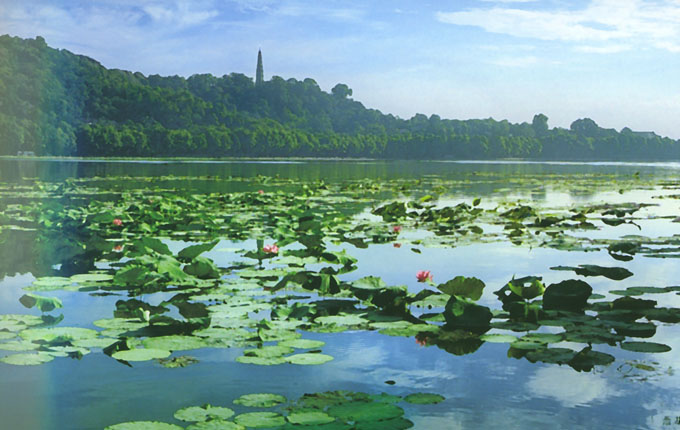
Located on China’s eastern coast, Hangzhou, the capital of Zhejiang Province, is one of the country’s most celebrated historical and cultural cities. As a major metropolis in the Yangtze River Delta, Hangzhou is renowned for its rich heritage, scenic beauty, and vibrant tourism industry. The city enjoys a warm, humid subtropical climate with four distinct seasons, making it an attractive destination for visitors throughout the year.
Hangzhou administers eight urban districts and several county-level cities and counties, covering a total area of approximately 16,596 square kilometers and home to a population of more than 6.1 million people. Best known for the UNESCO World Heritage-listed West Lake, as well as its historic temples, traditional tea plantations, and thriving modern economy, Hangzhou offers a perfect blend of natural beauty, cultural heritage, and contemporary urban life. Whether exploring ancient landmarks or enjoying its picturesque landscapes, visitors will discover why Hangzhou has long been regarded as one of China’s most beautiful cities.
Main attractions in Hangzhou
Lingyin Temple
Lingyin temple or "Soul's Retreat Temple", is one of the best-known Buddhist monasteries in China, built in 326 AD at the foot of Lingyin Mountain in Hangzhou. The main hall in Lingyin Temple is about 34 meters (111ft) tall - incredibly high for a one-story building. In the center of the hall there is a statue of Sakyamuni Buddha, which was carved from 24 pieces of camphor wood. The two stone pagodas in front of the hall were built in 960 during the Song dynasty (960-1271).
West Lake:
 "Rippling waters shimmering on a sunny day, Misty mountains shrouded in rain; Plain or gaily dressed like Xizi; West Lake is always alluring." These are the words used by the celebrated Song Dynasty poet Su Dongpo to describe Hangzhou’s West Lake. Regarded by many as China’s most beautiful lake, standing on its shores, it’s easy to understand Su’s allusion to Xizi, reputedly ancient China’s most beautiful woman. The subject of many of the country’s most famous literary and artistic works, and the inspiration for countless more, West Lake has for centuries been working its charm on all those who gaze upon it.
Longjing (Dragon Well) Tea:
Longjing Tea is most famous for its unique fragrance and flavor; flat, slender strips of tea leaves in bright green liquid. Furthermore, Longjing tea aids one's health in many ways regardless of your age. It is used to deter food poisoning, refresh the body, stop cavities, fight viruses, control high blood pressure, lower the blood sugar level, and to prevent cancer. Hence, Longjing tea is regarded as the elixir for health and is widely sold and accepted all over the world. The name Longjing is from a small village on the Fenghuang Hill, in Hangzhou Zhengjiang Province. It is said that residents in ancient times believed that a dragon dwelled there and controlled the rainfall. As a result, people went there from all the surrounding areas whenever there was a drought to pray for rainfall, from as early as the Three Kingdoms Period (221-280).
Liuheta (Six Harmonies Pagoda):
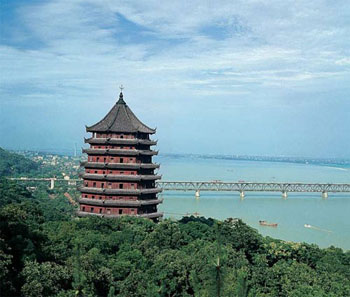
Liuheta Pagoda is a huge structure originally built during the Song dynasty in 971. It was originally designed as a lighthouse to help boats navigate the Qianliang River, which it overlooks. The pagoda was a Buddhist structure from the beginning and was named after the six regulations of Buddhism. As pagodas tend to do in China, this one burned down several times, but the basic form of the present pagoda dates to 1152, with the last major renovation occurring in 1900. The pagoda has 13 stories of rafters on the outside, but is divided into seven stories on the inside. The layout is an octagon, representing the Eightfold Path of Buddhism, with masonry and stone wall. What makes the pagoda so impressive is the floor space it occupies, several times greater than the footprint of other similarly aged pagodas in China. This is undoubtedly due to the use of two concentric octagons in the floor plan. This leaves a central niche on each floor, surrounded by a ring of halls. Wooden floors have been built jutting out from the second ring of stones, from which an excellent view of the river and the mountains can be taken in.
Climate in Hangzhou
Hangzhou has hot and humid summers and cool, relatively dry winters. In July the average high temperature is 33 degrees Celsius; in January the average high is 8 degree Celsius. Hangzhou receives an average annual rainfall of 1450 mm.
|
Month |
Jan |
Feb |
Mar |
Apr |
May |
Jun |
Jul |
Aug |
Sep |
Oct |
Nov |
Dec |
|
Temperature (Celsius) |
3.1 |
4.3 |
10.5 |
20.1 |
25.8 |
29.0 |
33.8 |
36.4 |
32.4 |
24.4 |
19.1 |
10.7 |
Click to see Hangzhou tours
China Attractions Guide
- Anhui Attractions
- Beijing Attractions
- Chongqing Attractions
- Fujian Attractions
- Gansu Attractions
- Guangdong Attractions
- Guangxi Attractions
- Guizhou Attractions
- Hainan Attractions
- Henan Attractions
- Hongkong Attractions
- Hubei Attractions
- Hunan Attractions
- Heilongjiang Attractions
- Inner Mongolia Attractions
- Jiangsu Attractions
- Jilin Attractions
- Jiangxi Attractions
- Liaoning Attractions
- Manchuria Attractions

